

 Global connections
 Research & archive







Historical material. Dates, proposals and invitations refer to the time of the original publication.
Two explanations of the conflict
Regarding the nature of this conflict, opinions have split into two widely represented camps. Adherents of the view that this is a conflict defining contemporary geopolitics constitute 41%. However, an even more significant portion (59%) is convinced that this conflict is primarily economic competition within the framework of the global economy between the countries of the Golden Billion and developing countries.
How the conflict is described
| Economic competition | 44.4% |
|---|---|
| Geopolitical conflict | 31.4% |
| Other | 3% |
| Don’t know | 21.2% |
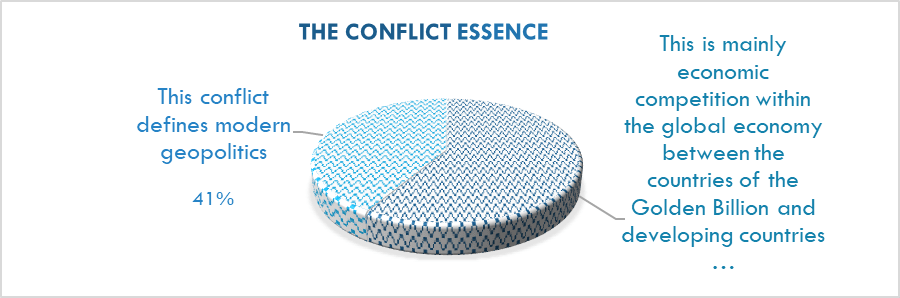
The matching Russian and English tables show 21.2% unable to define the conflict:28% of women and 14.8% of men [editorial clarification].
Social groups
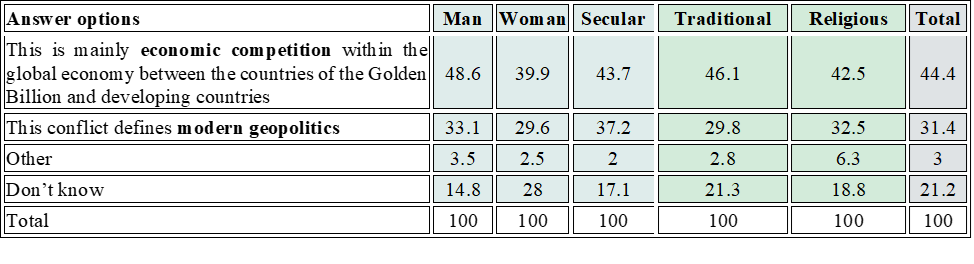
This question is a rare case where there is no fundamental difference in the answers between secular, observant and religious Israelis. There is not much difference in the answers of respondents separated by educational level. Perhaps respondents with the lowest educational level speak much less often about the geopolitical essence of the conflict (24.1% and about 33% in other groups).
Table 2.1. If such a conflict exists, which of the following definitions, in your opinion, characterizes its essence? %
| Group | Economic competition | Geopolitical conflict | Other | Don’t know |
|---|---|---|---|---|
| Men | 48.6% | 33.1% | 3.5% | 14.8% |
| Women | 39.9% | 29.6% | 2.5% | 28% |
| Secular | 43.7% | 37.2% | 2% | 17.1% |
| Traditional | 46.1% | 29.8% | 2.8% | 21.3% |
| Religious | 42.5% | 32.5% | 6.3% | 18.8% |
| All respondents | 44.4% | 31.4% | 3% | 21.2% |
Birthplace and sector
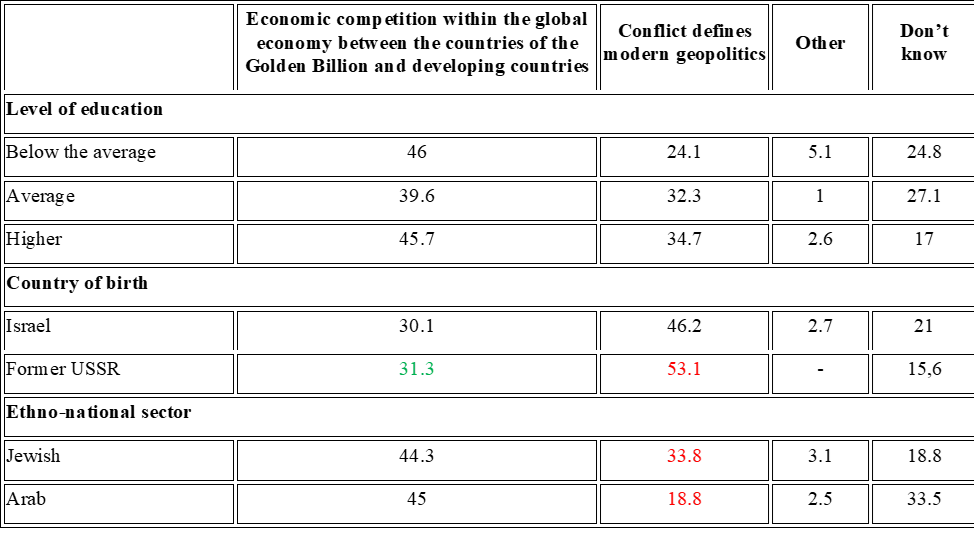
The published tables show former-USSR-born respondents selecting the geopolitical explanation more often than Israel-born respondents:53.1% versus 46.2%. The economic explanation is selected by 31.3% and 30.1%, respectively. The geopolitical explanation is more common in the Jewish than Arab sector:33.8% versus 18.8%; Arab respondents are more likely to be unsure. Figures follow both tables; the conflicting original paragraph is retained.
Table 2.2. If such a conflict exists, which of the following definitions do you think best describes it? % / education
| Group | Economic competition | Geopolitical conflict | Other | Don’t know |
|---|---|---|---|---|
| Below secondary | 46% | 24.1% | 5.1% | 24.8% |
| Secondary | 39.6% | 32.3% | 1% | 27.1% |
| Higher education | 45.7% | 34.7% | 2.6% | 17% |
| Group | Economic competition | Geopolitical conflict | Other | Don’t know |
|---|---|---|---|---|
| Born in Israel | 30.1% | 46.2% | 2.7% | 21% |
| Born in the former USSR | 31.3% | 53.1% | — | 15.6% |
| Group | Economic competition | Geopolitical conflict | Other | Don’t know |
|---|---|---|---|---|
| Jewish sector | 44.3% | 33.8% | 3.1% | 18.8% |
| Arab sector | 45% | 18.8% | 2.5% | 33.5% |
Belief in the existence of the conflict
Among respondents believing the conflict exists,39.5% choose the geopolitical explanation; among those denying its existence,22.4% do so. This compares two groups on the same response. The economic explanation is 50% and 48.3%, respectively [editorial clarification].
Table 2.3. Contingency table of data on the existence of a conflict between the South and the West and its essence
| Response | Do not believe the conflict exists | Believe the conflict exists |
|---|---|---|
| Economic competition | 48.3% | 50% |
| Geopolitical conflict | 22.4% | 39.5% |
