
 Global connections
 Research & archive






Perceptions of Foreign Information Influence and Media Discourse in Israeli Society
A study conducted under the Haifa Format project with the Geocartography Knowledge Group. Results: October 2026.
65.7% of respondents believe foreign states run a long-term influence program. At the same time, 56.1% describe Israel’s own information effort as mainly reactive, and 57.4% do not believe the country has a well-thought-out long-term program abroad.
How the study was conducted
The study is based on an online survey of 1,003 internet users aged 18 and older. The sample is nationally representative of Israel's adult internet-using population, with Jewish and Arab respondents included in proportion to their share of the population.
Fieldwork took place in mid-October 2026. Under the report’s stated methodology, the maximum margin for the full sample is ±3.1 percentage points at the 95% confidence level.
The study measures respondents’ perceptions. It does not measure actual foreign influence or, by itself, establish that intervention programs exist.
The report’s stated ±3.1 percentage-point margin applies to the full sample of 1,003. Subgroups are smaller; their N appears in each table. Small-subgroup comparisons are descriptive and have not been separately tested for statistical significance.
Questions 3–4 were answered by 774 respondents who named a country or bloc. The respondent base for questions 8–14 depends on selections in question 7. Differences of 0.1–0.2 percentage points between rounded cells and reported totals may reflect rounding; original table values are retained.
Foreign influence and Israel’s information policy
1. Is there a long-term foreign influence program?
Table 1. In your opinion, are foreign states currently running a long-term program designed to influence Israeli citizens' political views and election outcomes? Base: 1003 respondents.
Overall distribution of responses
- Definitely yes
- 22.4%
- Probably yes
- 43.3%
- Probably not
- 13.3%
- Definitely not
- 3.4%
- Don't know
- 17.6%
Base: N=1,003
Full table by respondent group
| Response | All respondents | Secular | Traditional | Religious / Haredi | Jewish | Arab |
|---|---|---|---|---|---|---|
| Definitely yes | 22.4% | 25.4% | 19.9% | 28.0% | 23.9% | 13.9% |
| Probably yes | 43.3% | 43.1% | 47.5% | 45.3% | 45.1% | 33.1% |
| Probably not | 13.3% | 13.2% | 11.4% | 10.6% | 12.1% | 19.9% |
| Definitely not | 3.4% | 2.0% | 3.7% | 3.1% | 2.8% | 6.6% |
| Don't know | 17.6% | 16.2% | 17.5% | 13.0% | 16.1% | 26.5% |
| Net "yes" | 65.7% | 68.5% | 67.3% | 73.3% | 69.0% | 47.0% |
| Total | 100.0% | 100.0% | 100.0% | 100.0% | 100.0% | 100.0% |
| N | 1,003 | 394 | 297 | 161 | 852 | 151 |
Original figures in Russian
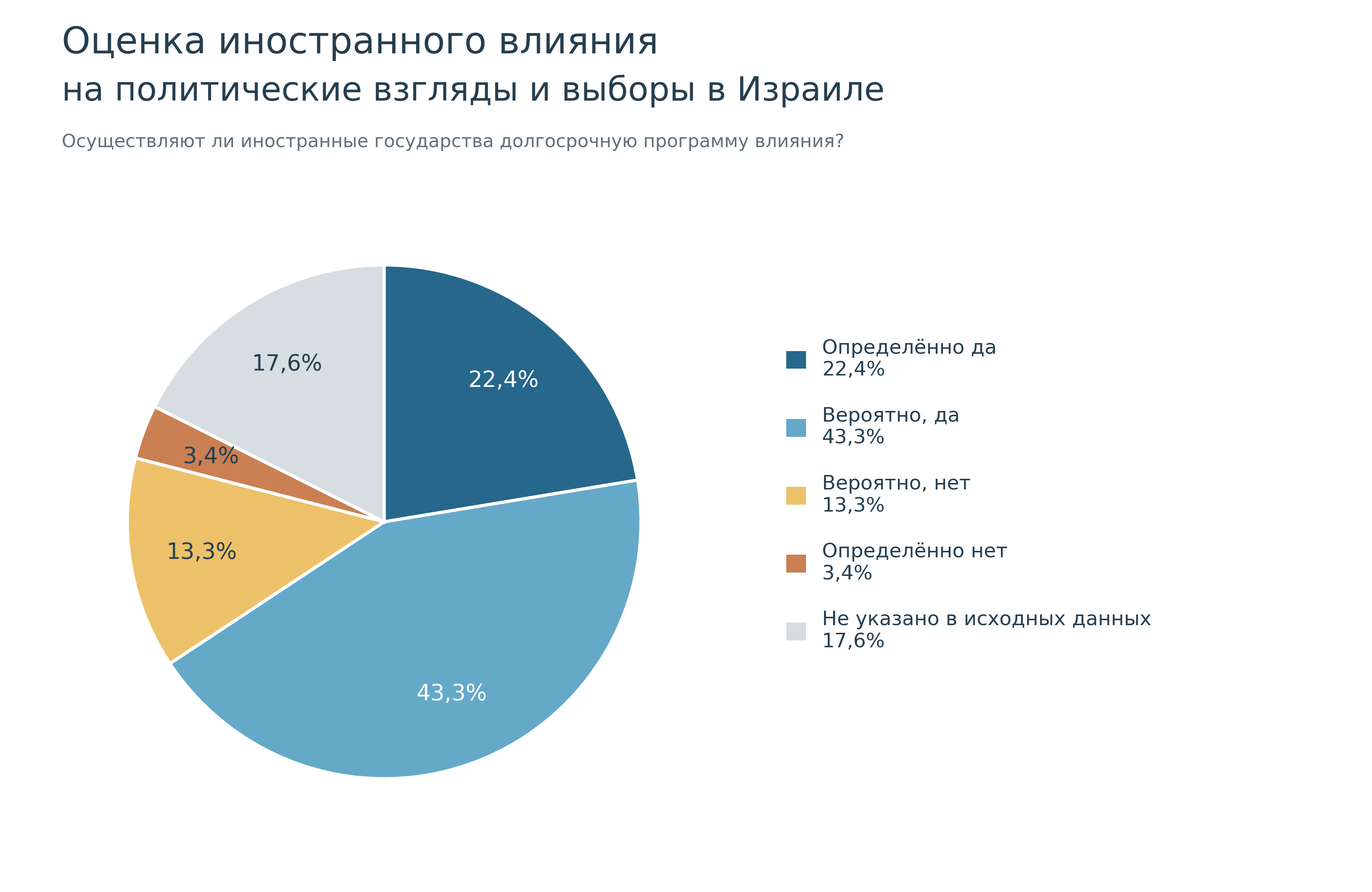
A clear majority of respondents (65.7%) believe a long-term foreign influence program exists. Only 16.7% lean the other way. Among Jewish respondents the figure is 69.0%. Among Arab citizens of Israel it is much lower, at 47.0%. Arab respondents are also more likely to be unsure (26.5% "don't know," vs. 16.1% of Jewish respondents) and to reject the idea (26.5% combined "no," vs. 14.9% of Jewish respondents).
2. Which countries are seen as most influential?
Table 2. In your opinion, which of the following countries or blocs has the greatest influence on Israelis' political views through its statements and communications policy? Base: 1003 respondents. Multiple responses allowed; percentages may sum to more than 100%.
Full table by respondent group
| Response | All respondents | Secular | Traditional | Religious / Haredi | Jewish | Arab |
|---|---|---|---|---|---|---|
| United States | 51.4% | 54.3% | 50.5% | 52.2% | 52.6% | 45.0% |
| Qatar | 28.4% | 36.5% | 29.6% | 24.2% | 31.8% | 9.3% |
| Iran | 28.0% | 33.0% | 30.0% | 24.2% | 30.3% | 15.2% |
| EU countries | 21.0% | 17.8% | 21.2% | 35.4% | 22.3% | 13.9% |
| Russia | 20.7% | 27.4% | 17.8% | 21.7% | 23.0% | 7.9% |
| Turkey | 13.8% | 14.7% | 15.5% | 13.7% | 14.8% | 7.9% |
| Ukraine | 3.3% | 3.0% | 4.0% | 3.7% | 3.5% | 2.0% |
| None of these countries | 6.2% | 6.1% | 5.1% | 6.8% | 5.9% | 7.9% |
| Don't know | 16.7% | 12.7% | 15.2% | 16.8% | 14.3% | 29.8% |
| Total | 189.5% | 205.6% | 188.9% | 198.8% | 198.5% | 139.1% |
| N | 1,003 | 394 | 297 | 161 | 852 | 151 |
Original figures in Russian
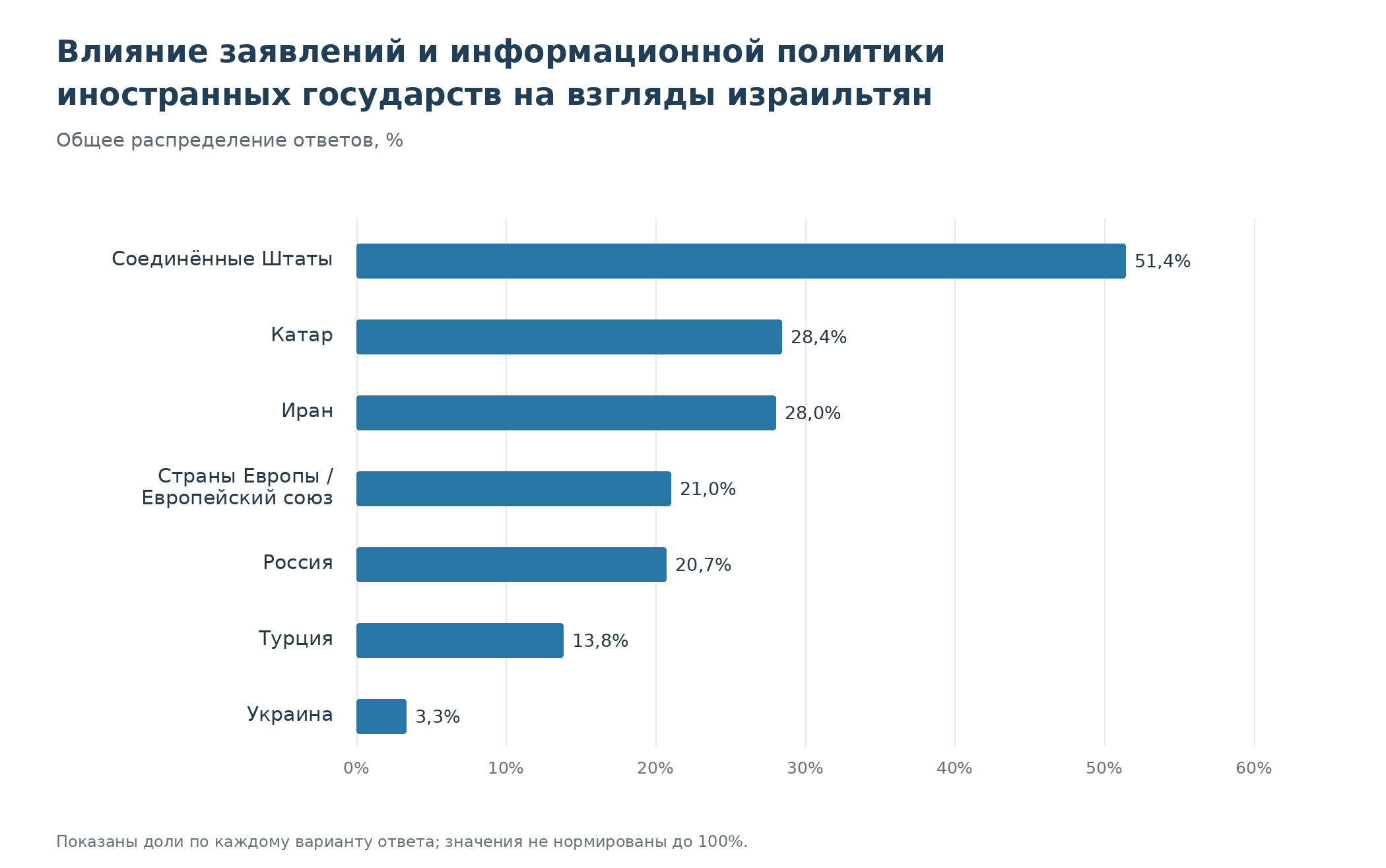
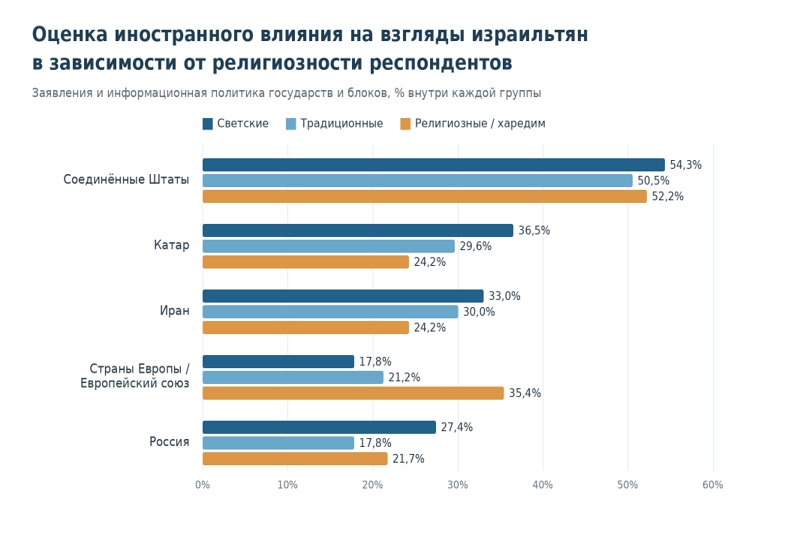
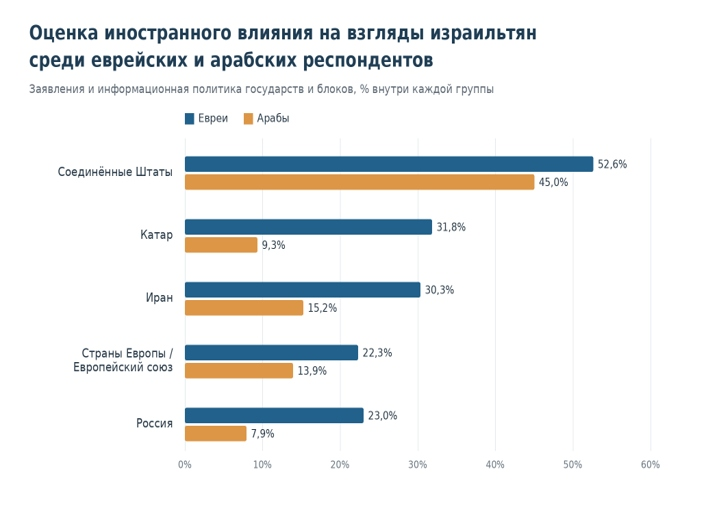
Respondents see the United States as by far the most influential, with 51.4% naming it. Qatar (28.4%) and Iran (28.0%) are nearly tied for second, followed by the EU (21.0%) and Russia (20.7%).
Views of Qatar, Iran, and the EU shift with religiosity. As religiosity rises, the share naming Qatar and Iran falls steadily, and the share naming the EU climbs from 17.8% among secular respondents to 35.4% among religious and Haredi respondents.
Jewish respondents name Qatar (31.8%), Iran (30.3%), and Russia (23.0%) far more often than Arab respondents do (9.3%, 15.2%, and 7.9%, respectively).
3. Information campaigns and social divisions
Table 3. In your opinion, to what extent do international information campaigns against Israel deepen divisions in society and stoke hostility? (Asked of respondents who named a country or bloc) Base: 774 respondents.
Full table by respondent group
| Response | All respondents | Secular | Traditional | Religious / Haredi | Jewish | Arab |
|---|---|---|---|---|---|---|
| To a very great extent | 37.1% | 35.9% | 40.9% | 43.9% | 39.1% | 22.3% |
| To a great extent | 41.2% | 42.8% | 38.0% | 41.5% | 40.9% | 43.6% |
| To a small extent | 14.6% | 15.3% | 15.6% | 7.3% | 14.0% | 19.1% |
| Not at all | 3.7% | 2.2% | 4.2% | 4.1% | 3.2% | 7.4% |
| Don't know | 3.4% | 3.8% | 1.3% | 3.3% | 2.8% | 7.4% |
| Top 2 | 78.3% | 78.8% | 78.9% | 85.4% | 80.0% | 66.0% |
| Total | 100.0% | 100.0% | 100.0% | 100.0% | 100.0% | 100.0% |
| N | 774 | 320 | 237 | 123 | 680 | 94 |
Original figures in Russian
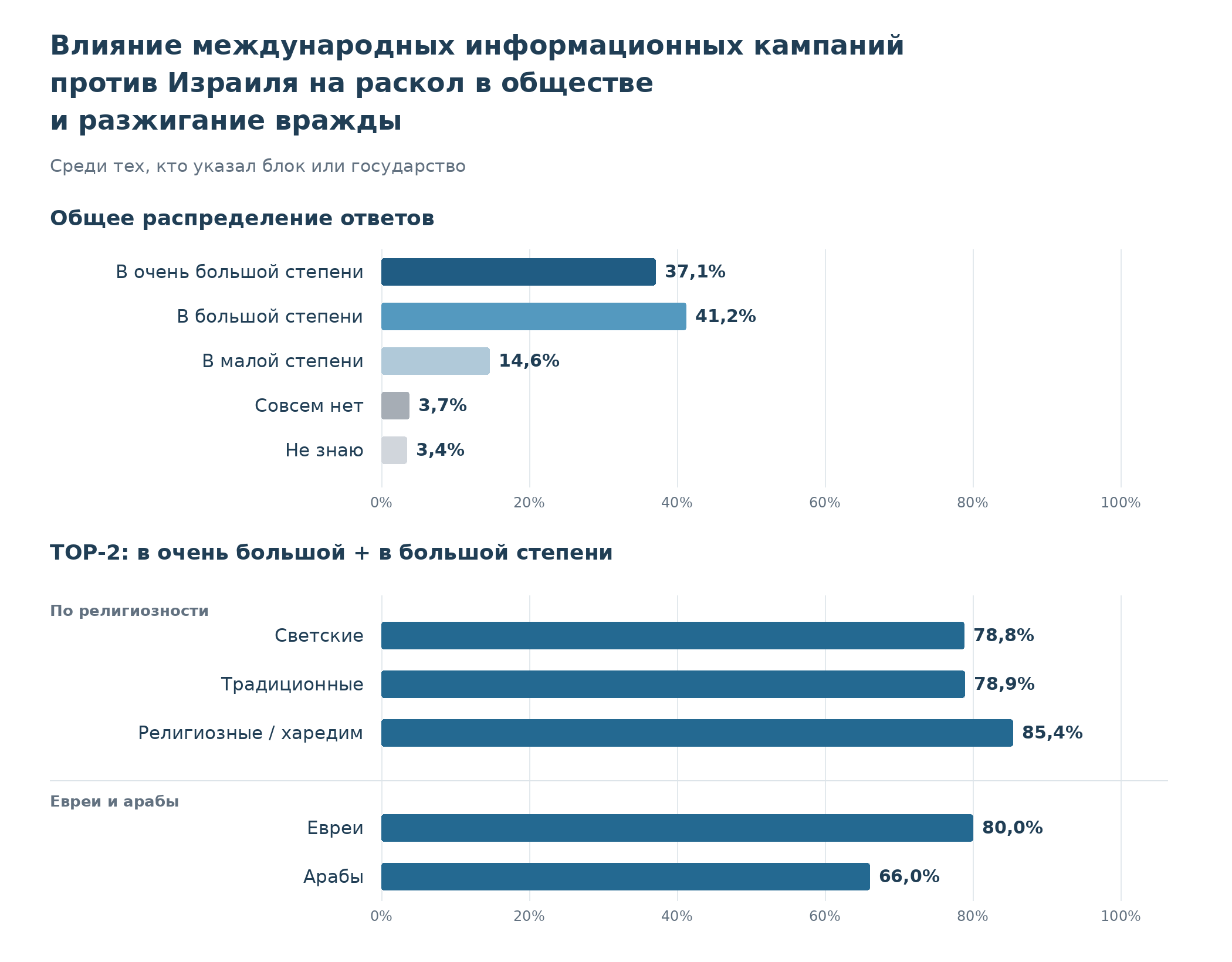
Among respondents who named a country or bloc (N=774), 78.3% believe foreign information campaigns deepen divisions in Israel to a great or very great extent. The view is most common among religious and Haredi respondents (85.4%) and less common among Arab respondents (66.0%).
4. Information campaigns and political power
Table 4. In your opinion, to what extent do international information campaigns against Israel help bring particular political forces to power? (Asked of respondents who named a country or bloc) Base: 774 respondents.
Full table by respondent group
| Response | All respondents | Secular | Traditional | Religious / Haredi | Jewish | Arab |
|---|---|---|---|---|---|---|
| To a very great extent | 26.1% | 26.6% | 26.2% | 30.1% | 27.1% | 19.1% |
| To a great extent | 45.0% | 39.7% | 47.7% | 48.0% | 44.0% | 52.1% |
| To a small extent | 20.3% | 22.5% | 20.7% | 17.9% | 21.0% | 14.9% |
| Not at all | 3.2% | 3.8% | 3.0% | 1.6% | 3.1% | 4.3% |
| Don't know | 5.4% | 7.5% | 2.5% | 2.4% | 4.9% | 9.6% |
| Top 2 | 71.1% | 66.3% | 73.8% | 78.0% | 71.0% | 71.3% |
| Total | 100.0% | 100.0% | 100.0% | 100.0% | 100.0% | 100.0% |
| N | 774 | 320 | 237 | 123 | 680 | 94 |
Original figures in Russian
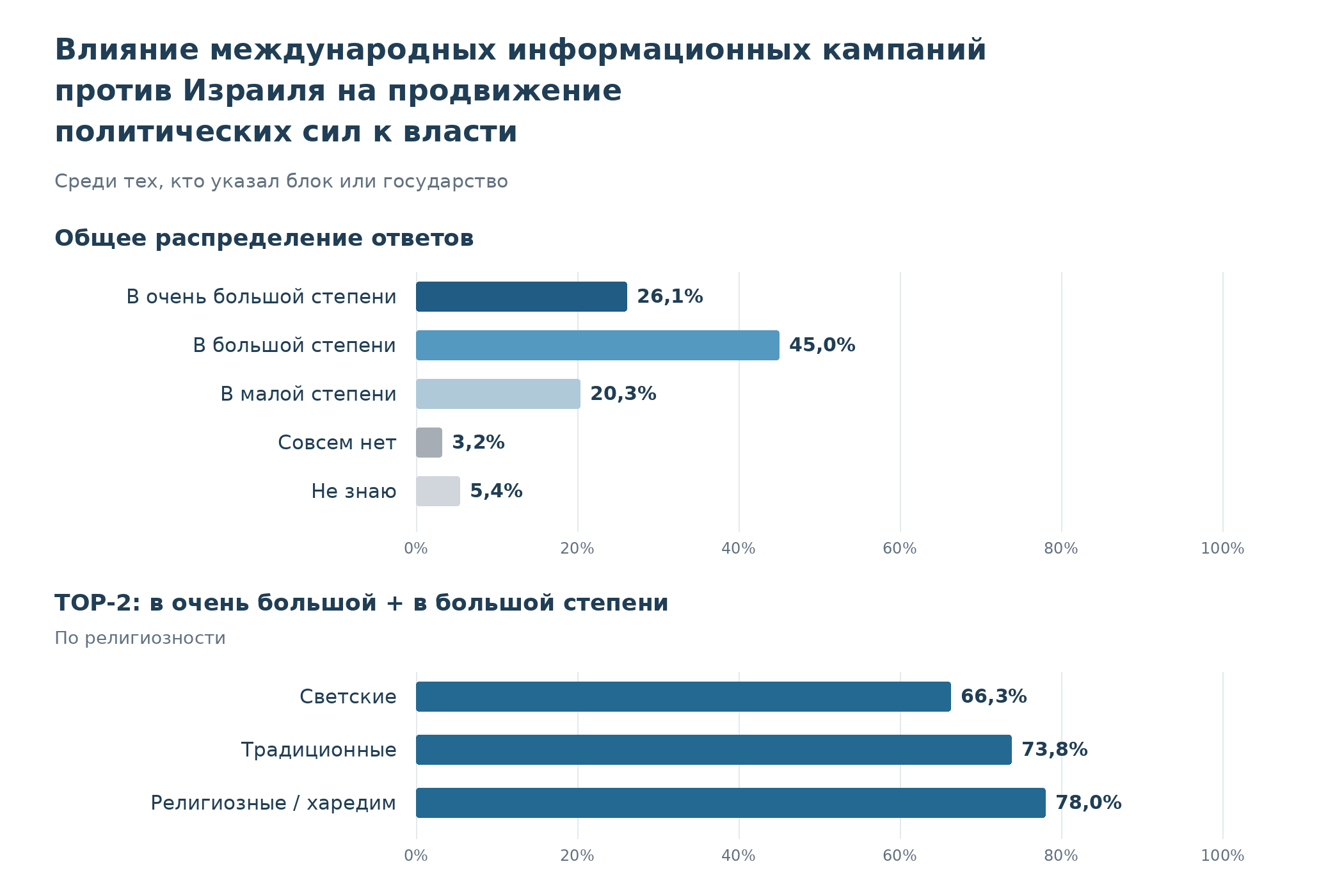
Overall, 71.1% of respondents (26.1% "to a very great extent," 45.0% "to a great extent") believe outside forces substantially shape Israel's political balance and help decide who comes to power. The base is the 774 respondents who named a country or bloc.
This view grows more common with religiosity, from 66.3% among secular respondents to 73.8% among traditional respondents and 78.0% among religious and Haredi respondents.
5. Israel reacts more than it sets the agenda
Table 5. In your opinion, which of the following best describes how Israel mainly operates in the international information arena? Base: 1003 respondents.
By respondent religiosity
| Secular | Traditional | Religious / Haredi | |
|---|---|---|---|
| Reacts, defends itself, and rebuts accusations | Secular64.2% | Traditional56.2% | Religious / Haredi53.4% |
| Takes the initiative and reacts in equal measure | Secular7.6% | Traditional15.8% | Religious / Haredi18.6% |
Rows: groups named. Columns: respondents answering. Base: Secular N=394 · Traditional N=297 · Religious / Haredi N=161
Who more often sees Israel as responding to accusations?
- Jewish respondents
- 59.4%
- Arab respondents
- 37.7%
Percentages within each respondent group. Base: Jewish respondents N=852 · Arab respondents N=151
Full table by respondent group
| Response | All respondents | Secular | Traditional | Religious / Haredi | Jewish | Arab |
|---|---|---|---|---|---|---|
| Reacts, defends itself, and rebuts accusations | 56.1% | 64.2% | 56.2% | 53.4% | 59.4% | 37.7% |
| Takes the initiative and reacts in equal measure | 13.0% | 7.6% | 15.8% | 18.6% | 12.6% | 15.2% |
| Takes the initiative and sets the agenda | 9.5% | 5.8% | 9.8% | 12.4% | 8.5% | 15.2% |
| Don't know | 21.4% | 22.3% | 18.2% | 15.5% | 19.6% | 31.8% |
| Total | 100.0% | 100.0% | 100.0% | 100.0% | 100.0% | 100.0% |
| N | 1,003 | 394 | 297 | 161 | 852 | 151 |
Original figures in Russian
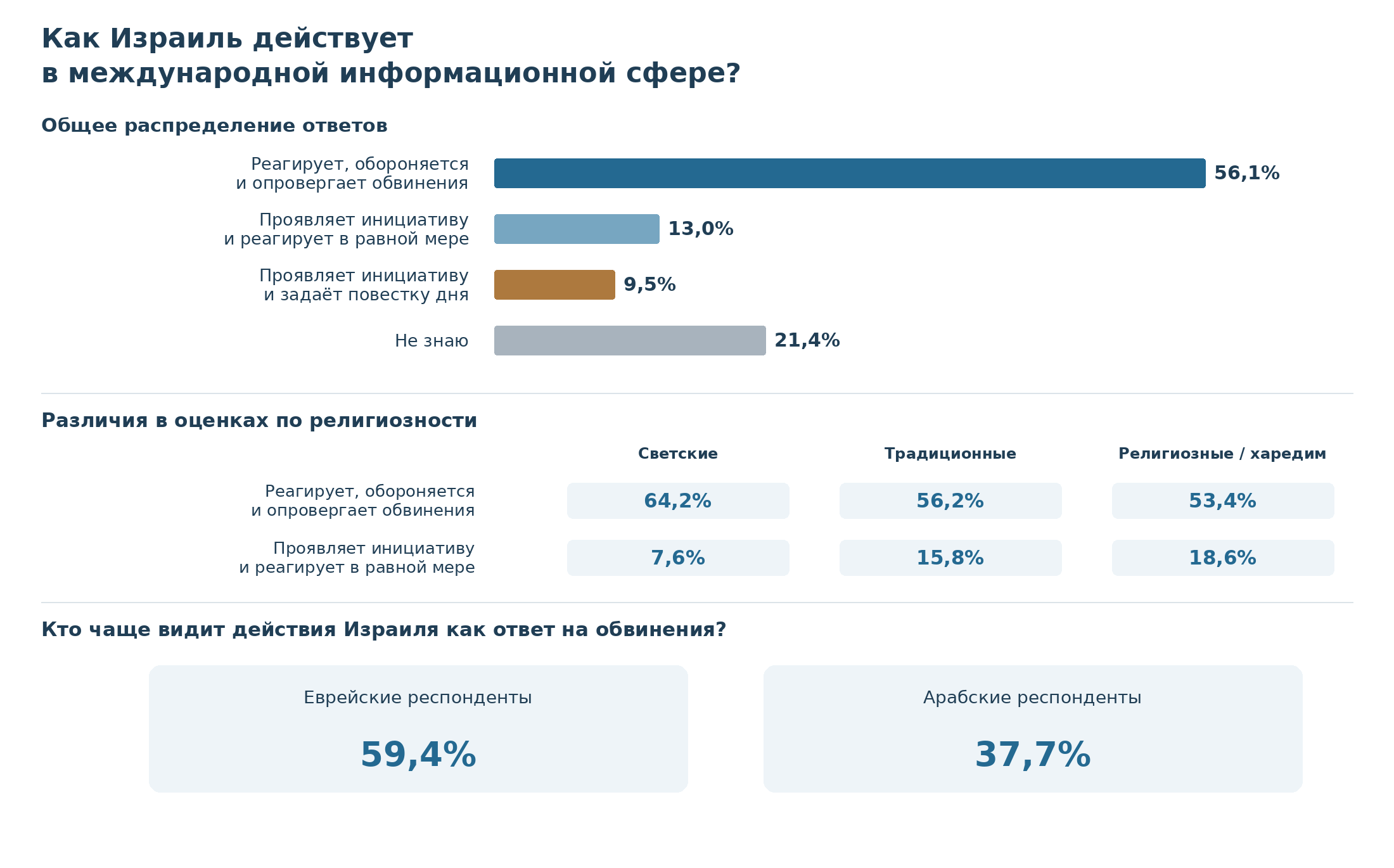
The prevailing view (56.1%) is that Israel mainly reacts, defends itself, and rebuts accusations. Secular respondents hold this view most often, and its share falls as religiosity rises (64.2% among secular respondents, 56.2% among traditional respondents, and 53.4% among religious and Haredi respondents). Only 9.5% believe the country takes the initiative and sets the agenda. Religious and Arab respondents say so somewhat more often than others.
Jewish respondents are far more likely to see Israel's information effort as reactive (59.4%) than Arab respondents (37.7%). Nearly a third of Arab respondents (31.8%) answered "don't know."
6. Does Israel have an information strategy abroad?
Table 6. In your opinion, does Israel have a well-thought-out long-term program for information influence abroad? Base: 1003 respondents.
Base: N=1,003
Definitely yes + probably yes, by religiosity
- Secular
- 18.5%
- Traditional
- 35.4%
- Religious / Haredi
- 40.4%
Percentages within each respondent group. Base: Secular N=394 · Traditional N=297 · Religious / Haredi N=161
Full table by respondent group
| Response | All respondents | Secular | Traditional | Religious / Haredi | Jewish | Arab |
|---|---|---|---|---|---|---|
| Definitely yes | 6.4% | 3.0% | 8.4% | 5.6% | 5.4% | 11.9% |
| Probably yes | 23.2% | 15.5% | 26.9% | 34.8% | 23.1% | 23.8% |
| Probably not | 36.5% | 39.6% | 37.4% | 31.7% | 37.3% | 31.8% |
| Definitely not | 20.9% | 32.5% | 16.2% | 9.3% | 22.4% | 12.6% |
| Don't know | 13.0% | 9.4% | 11.1% | 18.6% | 11.7% | 19.9% |
| Net "yes" | 29.6% | 18.5% | 35.4% | 40.4% | 28.5% | 35.8% |
| Total | 100.0% | 100.0% | 100.0% | 100.0% | 100.0% | 100.0% |
| N | 1,003 | 394 | 297 | 161 | 852 | 151 |
Original figures in Russian
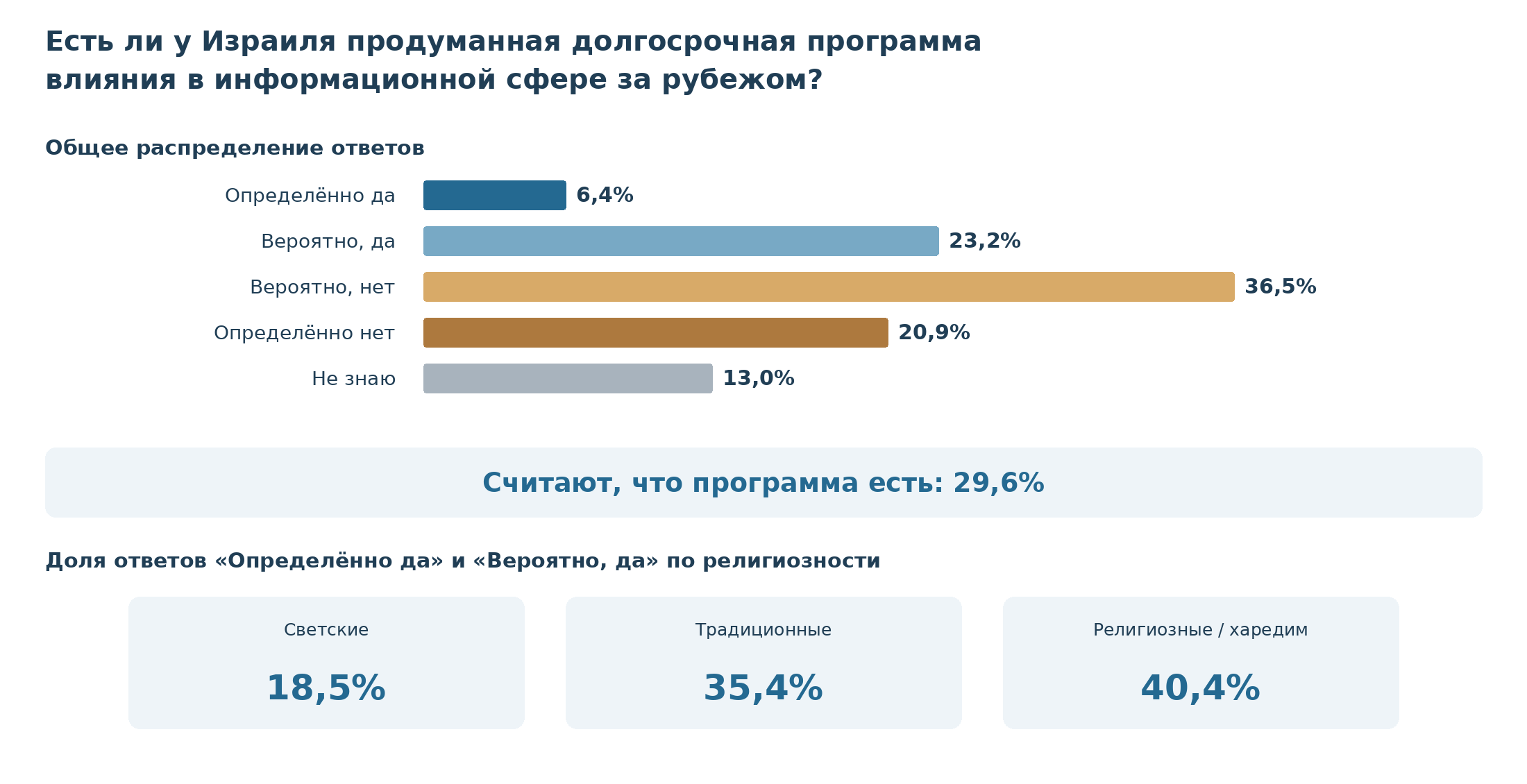
Most Israelis doubt that the country plans its information effort strategically. In total, 57.4% answer "no" (36.5% "probably not," 20.9% "definitely not"). Only 29.6% believe such a program exists. Belief in a program rises with religiosity. Only 18.5% of secular respondents believe Israel has one, and 32.5% say "definitely not." Among traditional respondents the share rises to 35.4%, and among religious and Haredi respondents it reaches 40.4%, with only 9.3% saying "definitely not." Arab respondents are somewhat more likely than Jewish respondents to believe Israel has such a program (35.8% vs. 28.5%).
Narratives and perceived social group profiles
7. Which claims are heard in public debate?
Table 7. International information campaigns often make the same claims heard inside Israel (listed below). Which of them are heard most often in Israel's public and political debate today? (Multiple responses allowed) Base: 1003 respondents. Multiple responses allowed; percentages may sum to more than 100%.
Full table by respondent group
| Response | All respondents | Secular | Traditional | Religious / Haredi | Jewish | Arab |
|---|---|---|---|---|---|---|
| The government's military and foreign policy decisions serve mainly to keep it in power | 32.7% | 41.9% | 27.3% | 24.2% | 33.5% | 28.5% |
| The West judges Israel by a different standard than other countries at war | 29.1% | 35.5% | 26.3% | 35.4% | 32.3% | 11.3% |
| International pressure stems mainly from the lack of an acceptable solution to the Palestinian issue | 22.8% | 19.5% | 30.3% | 22.4% | 23.8% | 17.2% |
| Key regional decisions should be coordinated with the U.S., even at the cost of Israel's freedom of action | 21.6% | 21.8% | 21.9% | 24.2% | 22.3% | 17.9% |
| Operations in Gaza should be significantly curtailed because of excessive harm to civilians | 20.2% | 18.3% | 20.9% | 18.6% | 19.2% | 25.8% |
| Civil society and the media should criticize the government even in wartime | 13.5% | 14.0% | 10.4% | 12.4% | 12.4% | 19.2% |
| Only a foreign policy independent of the U.S. and the EU serves Israel's interests | 10.8% | 8.6% | 14.1% | 11.8% | 11.2% | 8.6% |
| None of these claims | 4.4% | 3.0% | 6.1% | 5.6% | 4.6% | 3.3% |
| Don't know | 13.1% | 11.9% | 9.4% | 13.0% | 11.3% | 23.2% |
| Total | 168.2% | 174.6% | 166.7% | 167.7% | 170.5% | 155.0% |
| N | 1,003 | 394 | 297 | 161 | 852 | 151 |
Original figures in Russian
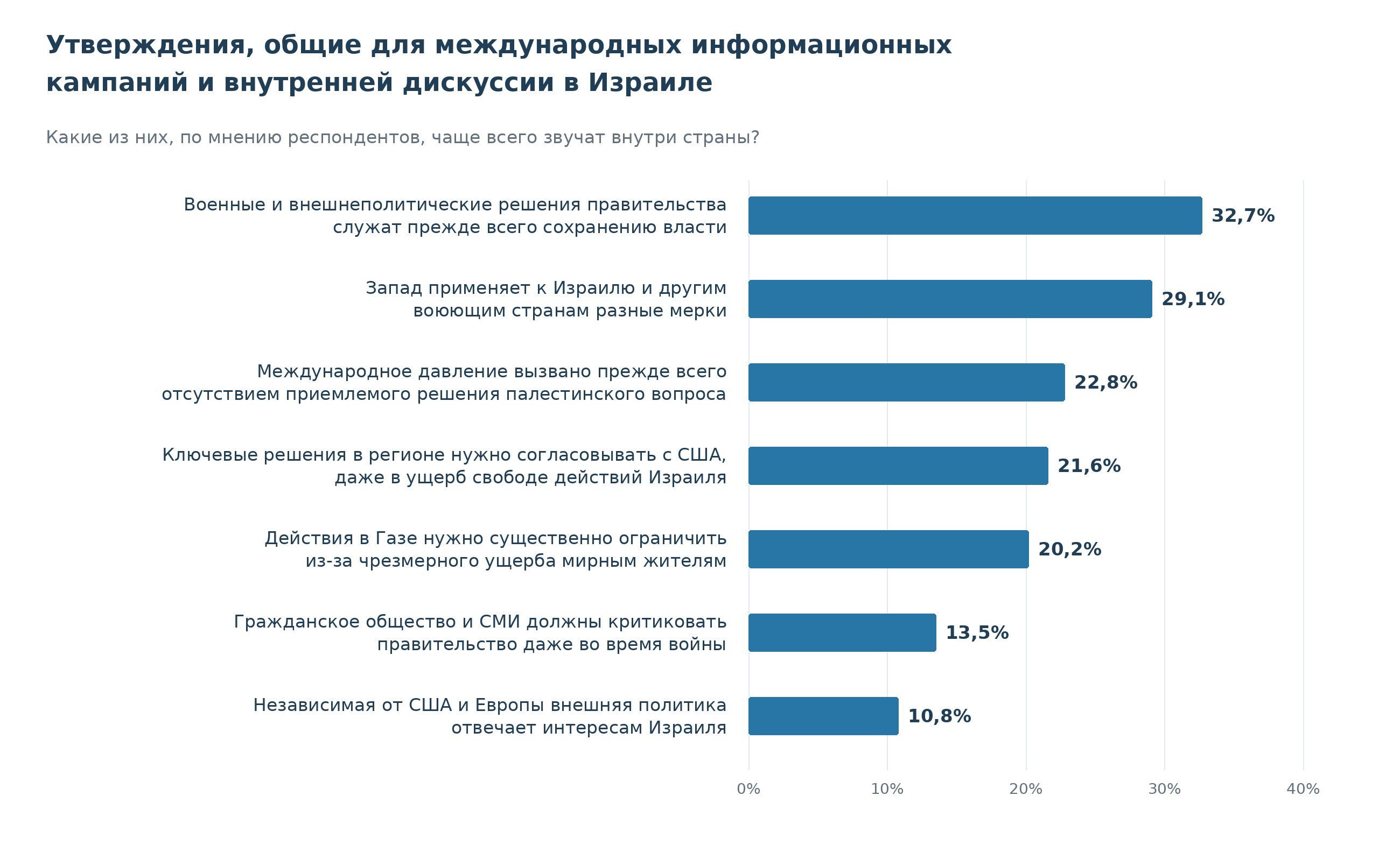
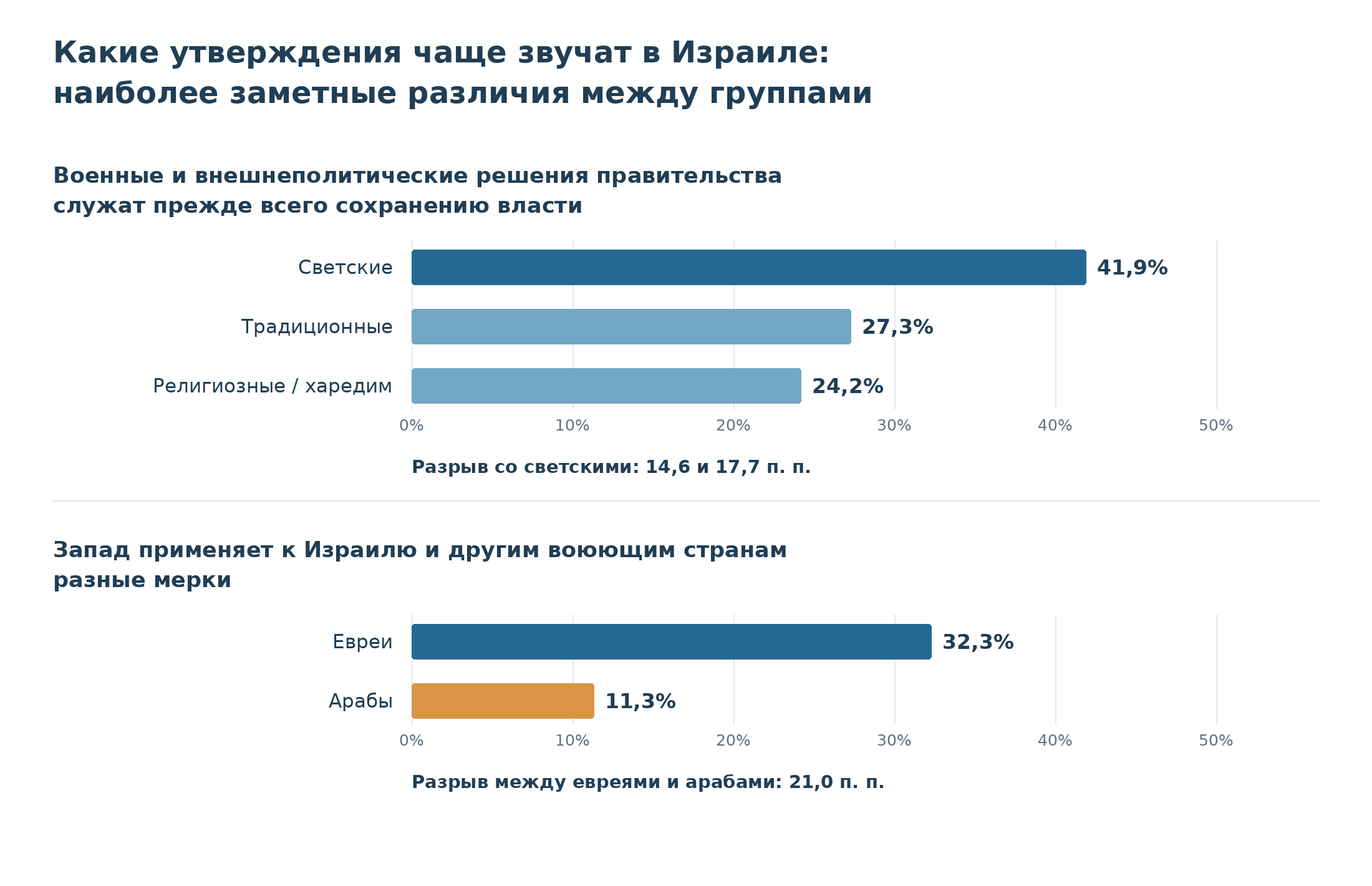
Of the claims shared by international anti-Israel campaigns and Israel's domestic debate, respondents most often named the claim that the government makes military and foreign policy decisions to stay in power (32.7%). Close behind is the claim that the West holds Israel to a different standard than other countries at war (29.1%).
Three claims form a second tier, each named by 20% to 23% of respondents. One attributes international pressure on Israel mainly to the lack of a Palestinian solution acceptable to the main parties. Another holds that Israel should coordinate its key regional decisions with the United States even if this limits its freedom of action. The third calls for significantly curtailing Israel's operations in Gaza because they cause too much harm to civilians. These figures measure which claims respondents hear in public debate, not personal agreement with them.
The least cited claim is that only a foreign policy independent of the United States and the EU serves Israel's interests (10.8%).
The sharpest divide by religiosity concerns the claim that the government's military and foreign policy decisions serve mainly to keep it in power. Secular respondents name it far more often (41.9%) than traditional respondents (27.3%) and religious and Haredi respondents (24.2%), a gap of roughly 15 to 18 percentage points.
Between Jewish and Arab respondents, the widest gap concerns Western double standards. This claim was named by 32.3% of Jewish respondents and only 11.3% of Arab respondents. Arab respondents, by contrast, are somewhat more likely to name the claims about excessive civilian harm in Gaza (25.8% vs. 19.2% of Jewish respondents) and about the need to criticize the government (19.2% vs. 12.4%).
8. Who is linked to the claim about civilian harm in Gaza?
Table 8. Which groups most often make the following claim? "Israel's operations in Gaza cause too much harm to civilians and should be significantly curtailed" Base: 203 respondents. Multiple responses allowed; percentages may sum to more than 100%. Asked only of respondents who selected this claim in question 7.
Who attributes this claim to the left? · By respondent religiosity
- Secular
- 86.1%
- Traditional
- 85.5%
Percentages within each respondent group. Base: Religious / Haredi N=30 · Secular N=72 · Traditional N=62
Who attributes this claim to the left? · Jewish and Arab respondents
- Arab respondents
- 53.8%
Percentages within each respondent group. Base: Jewish respondents N=164 · Arab respondents N=39
Full table by respondent group
| Response | All respondents | Secular | Traditional | Religious / Haredi | Jewish | Arab |
|---|---|---|---|---|---|---|
| The left | 81.3% | 86.1% | 85.5% | 96.7% | 87.8% | 53.8% |
| Israeli Arabs | 56.2% | 59.7% | 51.6% | 66.7% | 57.9% | 48.7% |
| Secular Israelis | 16.7% | 15.3% | 12.9% | 30.0% | 17.1% | 15.4% |
| The center | 15.8% | 19.4% | 11.3% | 13.3% | 15.2% | 17.9% |
| The right | 8.4% | 11.1% | 6.5% | 0.0% | 7.3% | 12.8% |
| Haredim | 5.4% | 5.6% | 4.8% | 0.0% | 4.3% | 10.3% |
| Religious Jews | 4.4% | 5.6% | 1.6% | 0.0% | 3.0% | 10.3% |
| All groups | 3.4% | 0.0% | 1.6% | 3.3% | 1.2% | 12.8% |
| None of these groups | 2.0% | 4.2% | 1.6% | 0.0% | 2.4% | 0.0% |
| Don't know | 3.4% | 1.4% | 0.0% | 0.0% | 0.6% | 15.4% |
| Total | 197.0% | 208.3% | 177.4% | 210.0% | 197.0% | 197.4% |
| N | 203 | 72 | 62 | 30 | 164 | 39 |
Original figures in Russian
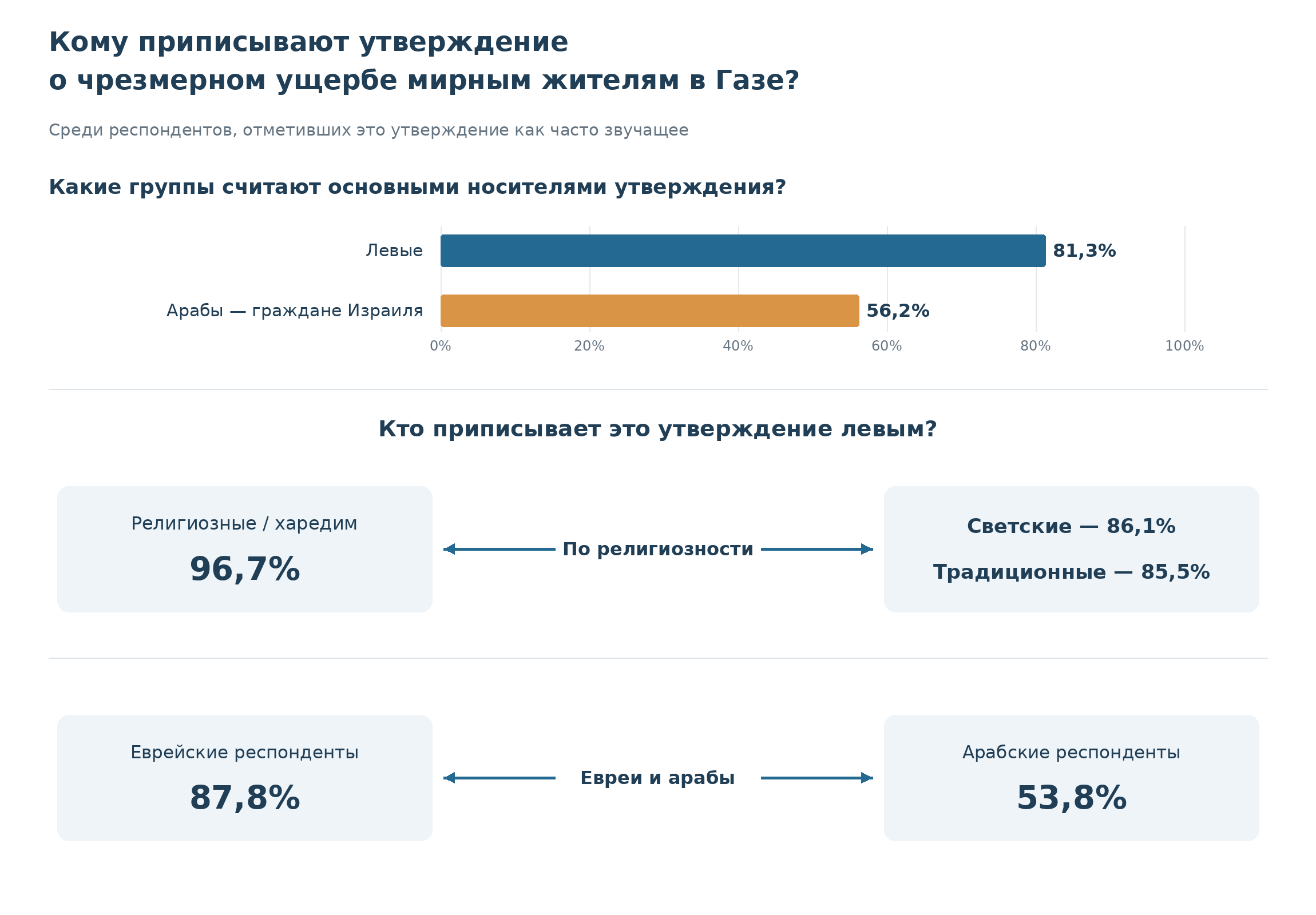
Respondents most often attribute the claim about excessive civilian harm in Gaza to the left (81.3%) and much less often to Arab citizens of Israel (56.2%). Religious and Haredi respondents link it to the left more often than any other group (96.7%). Jewish respondents are far more likely than Arab respondents to link the claim to the left (87.8% vs. 53.8%).
9. Who is linked to the claim about staying in power?
Table 9. Which groups most often make the following claim? "The government often makes military and foreign policy decisions mainly to stay in power" Base: 328 respondents. Multiple responses allowed; percentages may sum to more than 100%. Asked only of respondents who selected this claim in question 7.
Which groups are named by respondents of different religiosity?
| Secular | Traditional | Religious / Haredi | |
|---|---|---|---|
| The center | Secular50.3% | Traditional39.5% | Religious / Haredi20.5% |
| Secular Israelis | Secular40.6% | Traditional30.9% | Religious / Haredi15.4% |
Rows: groups named. Columns: respondents answering. Base: Secular N=165 · Traditional N=81 · Religious / Haredi N=39
Which groups are named by Jewish and Arab respondents?
| Jewish respondents | Arab respondents | |
|---|---|---|
| The left | Jewish respondents74.7% | Arab respondents37.2% |
| The center | Jewish respondents43.2% | Arab respondents18.6% |
| Secular Israelis | Jewish respondents34.4% | Arab respondents18.6% |
| The right | Jewish respondents21.1% | Arab respondents32.6% |
Rows: groups named. Columns: respondents answering. Base: Jewish respondents N=285 · Arab respondents N=43
Full table by respondent group
| Response | All respondents | Secular | Traditional | Religious / Haredi | Jewish | Arab |
|---|---|---|---|---|---|---|
| The left | 69.8% | 75.2% | 72.8% | 76.9% | 74.7% | 37.2% |
| The center | 39.9% | 50.3% | 39.5% | 20.5% | 43.2% | 18.6% |
| Secular Israelis | 32.3% | 40.6% | 30.9% | 15.4% | 34.4% | 18.6% |
| Israeli Arabs | 25.3% | 24.2% | 28.4% | 20.5% | 24.9% | 27.9% |
| The right | 22.6% | 23.0% | 19.8% | 15.4% | 21.1% | 32.6% |
| Religious Israelis | 10.4% | 12.1% | 8.6% | 7.7% | 10.5% | 9.3% |
| Haredim | 9.8% | 7.3% | 9.9% | 12.8% | 8.8% | 16.3% |
| All groups | 9.5% | 8.5% | 4.9% | 10.3% | 7.7% | 20.9% |
| None of these groups | 0.6% | 0.0% | 1.2% | 0.0% | 0.4% | 2.3% |
| Don't know | 5.2% | 3.6% | 3.7% | 7.7% | 4.2% | 11.6% |
| Total | 225.3% | 244.8% | 219.8% | 187.2% | 229.8% | 195.3% |
| N | 328 | 165 | 81 | 39 | 285 | 43 |
Original figures in Russian
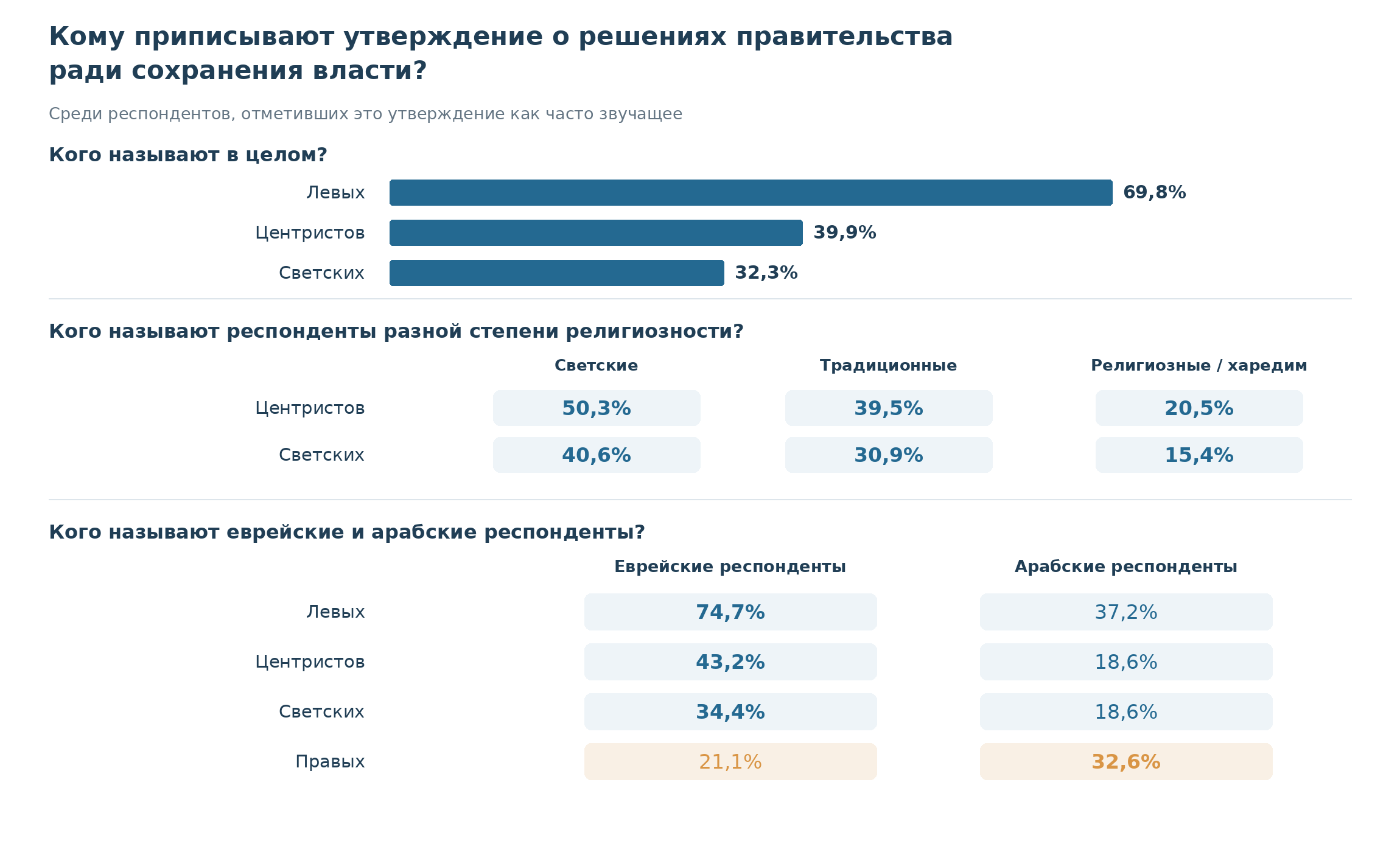
Respondents link the claim that the government makes decisions to stay in power mainly to the left (69.8%), and less often to the center (39.9%) and secular Israelis (32.3%).
The more religious the respondent, the less often they attribute this claim to centrists and secular Israelis. Between 40% and 50% of secular respondents name the center and secular Israelis as holders of this view, compared with 15% to 20% of religious and Haredi respondents.
Jewish respondents are much more likely than Arab respondents to attribute this claim to the left, the center, and secular Israelis. The left is the dominant choice among Jewish respondents (74.7%). Arab respondents are more likely than Jewish respondents to associate the claim with the right (32.6% vs. 21.1%).
10. Who is linked to the claim about international pressure?
Table 10. Which groups most often make the following claim? "International pressure on Israel stems mainly from the lack of a solution to the Palestinian issue acceptable to the main parties" Base: 229 respondents. Multiple responses allowed; percentages may sum to more than 100%. Asked only of respondents who selected this claim in question 7.
Which groups are named by respondents of different religiosity?
| Secular | Traditional | Religious / Haredi | |
|---|---|---|---|
| The center | Secular29.9% | Traditional18.9% | Religious / Haredi41.7% |
Rows: groups named. Columns: respondents answering. Base: Secular N=77 · Traditional N=90 · Religious / Haredi N=36
Which groups are named by Jewish and Arab respondents?
| Jewish respondents | Arab respondents | |
|---|---|---|
| The left | Jewish respondents63.5% | Arab respondents38.5% |
| Israeli Arabs | Jewish respondents32.0% | Arab respondents19.2% |
| Religious Israelis | Jewish respondents5.9% | Arab respondents15.4% |
Rows: groups named. Columns: respondents answering. Base: Jewish respondents N=203 · Arab respondents N=26
Full table by respondent group
| Response | All respondents | Secular | Traditional | Religious / Haredi | Jewish | Arab |
|---|---|---|---|---|---|---|
| The left | 60.7% | 67.5% | 55.6% | 75.0% | 63.5% | 38.5% |
| Israeli Arabs | 30.6% | 39.0% | 25.6% | 33.3% | 32.0% | 19.2% |
| The center | 27.9% | 29.9% | 18.9% | 41.7% | 27.1% | 34.6% |
| The right | 18.8% | 16.9% | 24.4% | 11.1% | 19.2% | 15.4% |
| Secular Israelis | 16.6% | 22.1% | 12.2% | 13.9% | 16.3% | 19.2% |
| Haredim | 7.0% | 2.6% | 12.2% | 2.8% | 6.9% | 7.7% |
| Religious Israelis | 7.0% | 3.9% | 10.0% | 0.0% | 5.9% | 15.4% |
| All groups | 11.4% | 14.3% | 10.0% | 2.8% | 10.3% | 19.2% |
| Don't know | 7.9% | 6.5% | 5.6% | 8.3% | 6.4% | 19.2% |
| Total | 187.8% | 202.6% | 174.4% | 188.9% | 187.7% | 188.5% |
| N | 229 | 77 | 90 | 36 | 203 | 26 |
Original figures in Russian
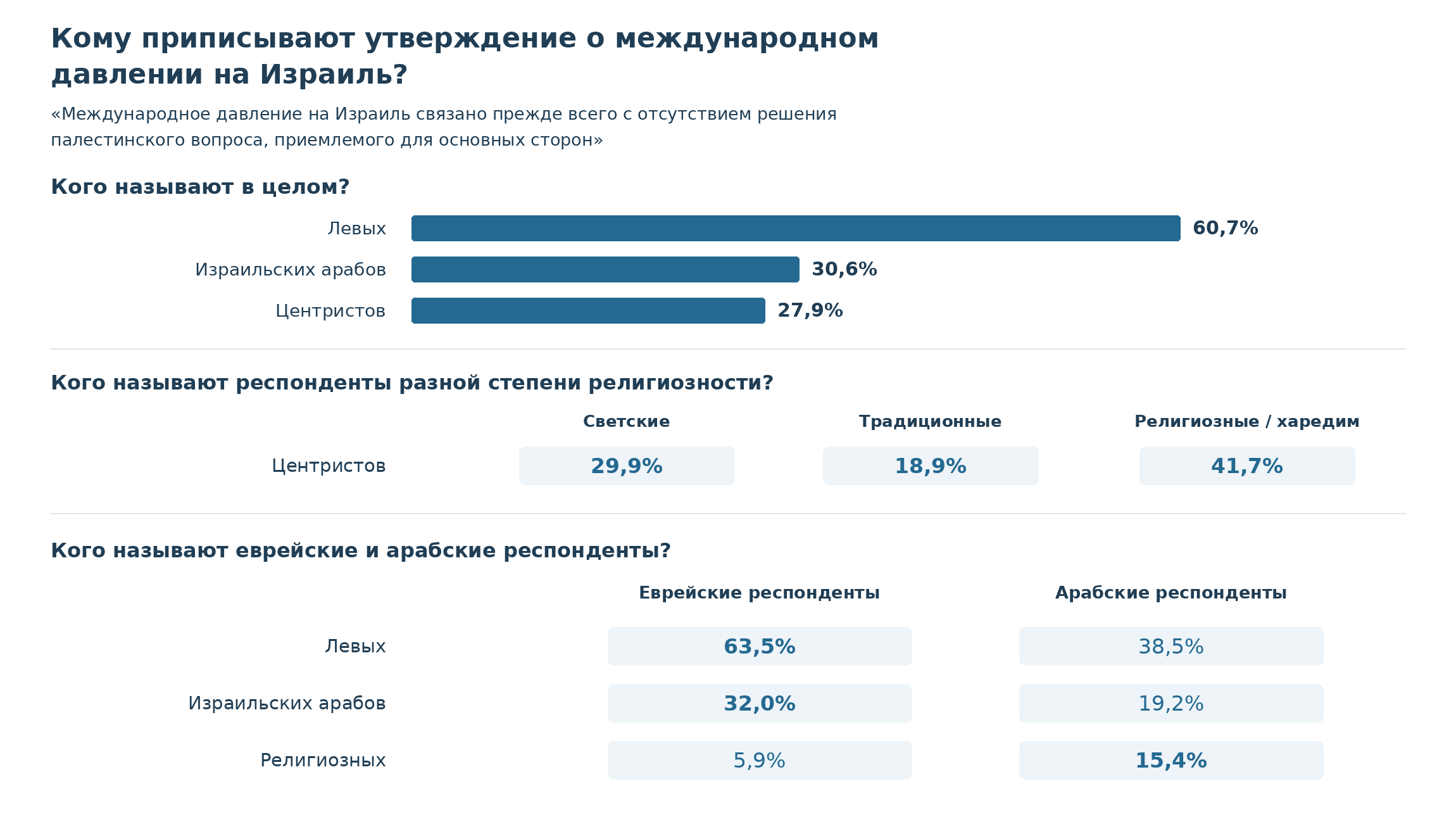
Respondents most often attribute this claim to the left (60.7%), followed by Arab citizens of Israel (30.6%) and the center (27.9%).
Religious respondents are more likely than secular respondents to attribute it to centrists (41.7% vs. 29.9%).
Jewish respondents are more likely than Arab respondents to attribute this claim to the left (63.5% vs. 38.5%) and to Arab citizens (32.0% vs. 19.2%). Arab respondents attribute it to religious Israelis more often than Jewish respondents do (15.4% vs. 5.9%).
11. Who is associated with an independent foreign policy?
Table 11. Which groups most often make the following claim? "A foreign policy as independent as possible of U.S. and European positions serves Israel's interests" Base: 108 respondents. Multiple responses allowed; percentages may sum to more than 100%. Asked only of respondents who selected this claim in question 7.
Who more often attributes this claim to the right?
- Secular
- 41.2%
- Traditional
- 47.6%
- Religious / Haredi
- 63.2%
Percentages within each respondent group. Base: Secular N=34 · Traditional N=42 · Religious / Haredi N=19
Which groups are named by Jewish and Arab respondents?
| Jewish respondents | Arab respondents | |
|---|---|---|
| The right | Jewish respondents48.4% | Arab respondents30.8% |
| Secular Jews | Jewish respondents21.1% | Arab respondents7.7% |
| All groups | Jewish respondents7.4% | Arab respondents23.1% |
Rows: groups named. Columns: respondents answering. Base: Jewish respondents N=95 · Arab respondents N=13
Full table by respondent group
| Response | All respondents | Secular | Traditional | Religious / Haredi | Jewish | Arab |
|---|---|---|---|---|---|---|
| The right | 46.3% | 41.2% | 47.6% | 63.2% | 48.4% | 30.8% |
| The center | 25.0% | 29.4% | 23.8% | 15.8% | 24.2% | 30.8% |
| Secular Jews | 19.4% | 26.5% | 19.0% | 15.8% | 21.1% | 7.7% |
| Religious Israelis | 16.7% | 17.6% | 9.5% | 31.6% | 16.8% | 15.4% |
| Haredim | 16.7% | 14.7% | 23.8% | 5.3% | 16.8% | 15.4% |
| The left | 13.9% | 20.6% | 11.9% | 10.5% | 14.7% | 7.7% |
| Israeli Arabs | 9.3% | 11.8% | 7.1% | 5.3% | 8.4% | 15.4% |
| All groups | 9.3% | 11.8% | 7.1% | 0.0% | 7.4% | 23.1% |
| None of these groups | 1.9% | 2.9% | 0.0% | 5.3% | 2.1% | 0.0% |
| Don't know | 15.7% | 17.6% | 11.9% | 15.8% | 14.7% | 23.1% |
| Total | 174.1% | 194.1% | 161.9% | 168.4% | 174.7% | 169.2% |
| N | 108 | 34 | 42 | 19 | 95 | 13 |
Original figures in Russian
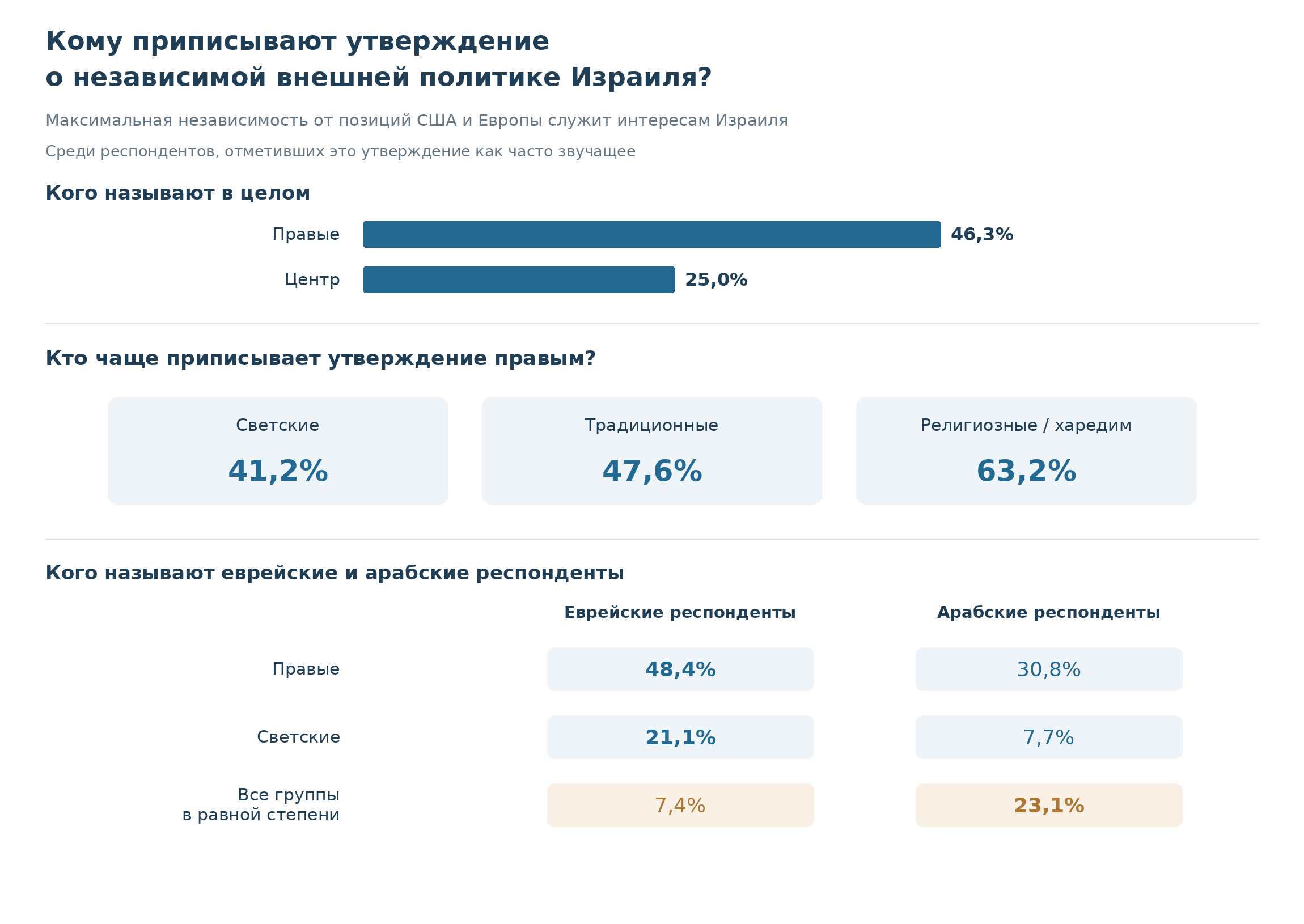
Respondents most often link the claim about an independent foreign policy to the right (46.3%), followed by the center (25.0%). The share naming the right is higher among religious and Haredi respondents (63.2%) than among traditional (47.6%) and secular respondents (41.2%). Secular respondents are more likely to link the center to this claim (29.4% vs. 15.8% of religious and Haredi respondents).
Among Jewish respondents, the right leads (48.4%). Among Arab respondents, the right and the center are tied at 30.8%. This last comparison is only indicative, since just 13 Arab respondents answered the question.
12. Who is associated with criticism during wartime?
Table 12. Which groups most often make the following claim? "Civil society and the media should keep criticizing the government even in wartime" Base: 135 respondents. Multiple responses allowed; percentages may sum to more than 100%. Asked only of respondents who selected this claim in question 7.
Which groups are named by respondents of different religiosity?
| Secular | Traditional | Religious / Haredi | |
|---|---|---|---|
| The left | Secular72.7% | Traditional58.1% | Religious / Haredi55.0% |
| The center | Secular56.4% | Traditional29.0% | Religious / Haredi30.0% |
| Secular Jews | Secular58.2% | Traditional19.4% | Religious / Haredi10.0% |
| All groups | Secular7.3% | Traditional16.1% | Religious / Haredi20.0% |
Rows: groups named. Columns: respondents answering. Base: Secular N=55 · Traditional N=31 · Religious / Haredi N=20
Which groups are named by Jewish and Arab respondents?
| Jewish respondents | Arab respondents | |
|---|---|---|
| The center | Jewish respondents43.4% | Arab respondents31.0% |
| Secular Jews | Jewish respondents37.7% | Arab respondents24.1% |
| All groups | Jewish respondents12.3% | Arab respondents37.9% |
Rows: groups named. Columns: respondents answering. Base: Jewish respondents N=106 · Arab respondents N=29
Full table by respondent group
| Response | All respondents | Secular | Traditional | Religious / Haredi | Jewish | Arab |
|---|---|---|---|---|---|---|
| The left | 63.0% | 72.7% | 58.1% | 55.0% | 65.1% | 55.2% |
| The center | 40.7% | 56.4% | 29.0% | 30.0% | 43.4% | 31.0% |
| Secular Jews | 34.8% | 58.2% | 19.4% | 10.0% | 37.7% | 24.1% |
| Israeli Arabs | 21.5% | 25.5% | 19.4% | 20.0% | 22.6% | 17.2% |
| The right | 14.1% | 9.1% | 22.6% | 15.0% | 14.2% | 13.8% |
| Haredim | 8.1% | 5.5% | 9.7% | 0.0% | 5.7% | 17.2% |
| Religious Jews | 6.7% | 5.5% | 9.7% | 5.0% | 6.6% | 6.9% |
| All groups | 17.8% | 7.3% | 16.1% | 20.0% | 12.3% | 37.9% |
| None of these groups | 3.0% | 3.6% | 0.0% | 5.0% | 2.8% | 3.4% |
| Don't know | 4.4% | 5.5% | 9.7% | 0.0% | 5.7% | 0.0% |
| Total | 214.1% | 249.1% | 193.5% | 160.0% | 216.0% | 206.9% |
| N | 135 | 55 | 31 | 20 | 106 | 29 |
Original figures in Russian
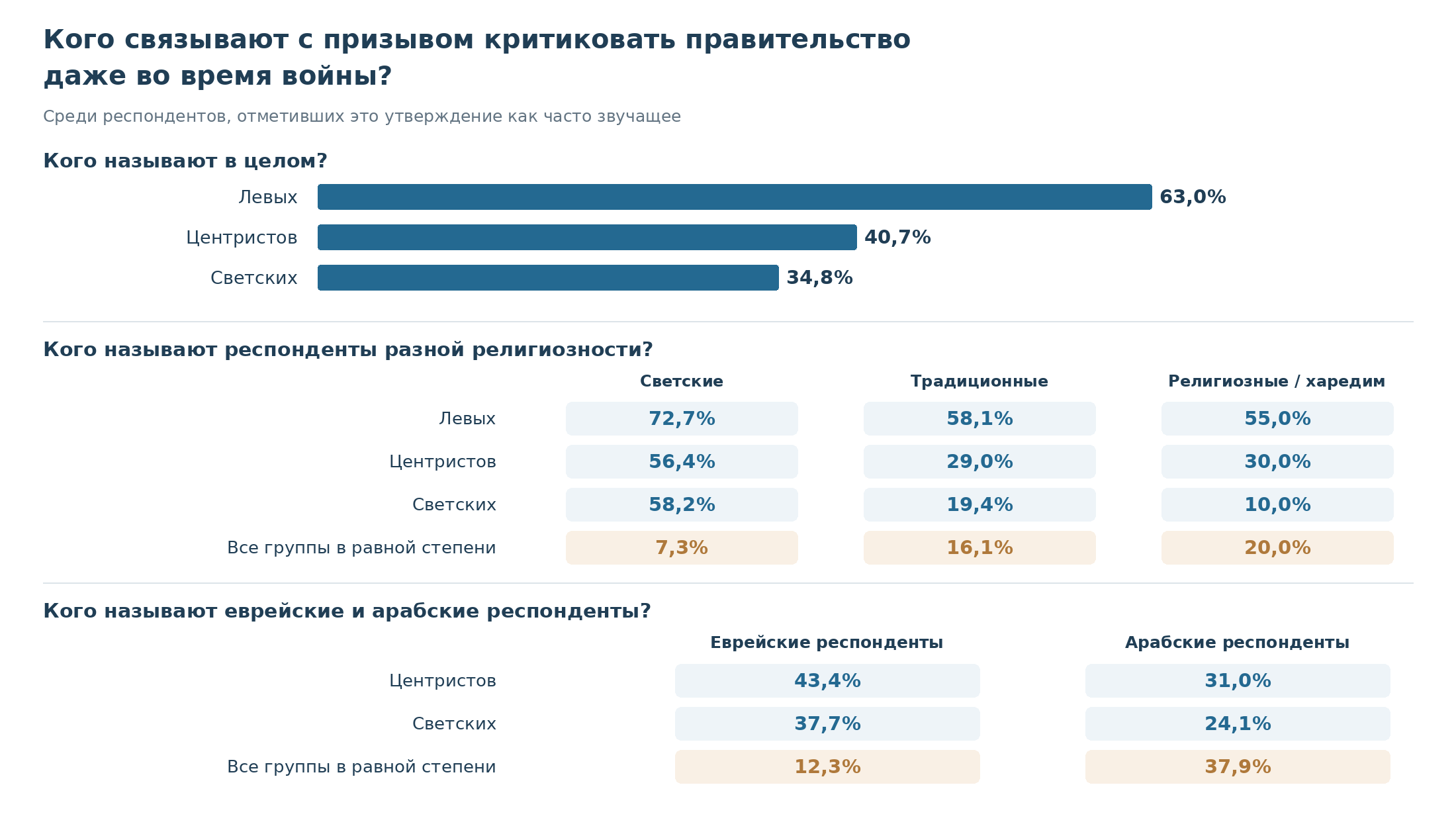
Respondents most often link the call to keep criticizing the government in wartime to the left (63.0%), the center (40.7%), and secular Jews (34.8%). Secular respondents are more likely than the other two groups to name both the left (72.7% vs. 58.1% among traditional and 55.0% among religious and Haredi respondents) and the center (56.4% vs. 29.0% and 30.0%) as holders of this view.
The left ranks first among both Jewish and Arab respondents (65.1% and 55.2%). Arab respondents, however, are far more likely to choose "all groups" (37.9% vs. 12.3%).
13. Who is associated with coordination with the U.S.?
Table 13. Which groups most often make the following claim? "Israel should coordinate key regional decisions with the United States, even if this limits its freedom of action" Base: 217 respondents. Multiple responses allowed; percentages may sum to more than 100%. Asked only of respondents who selected this claim in question 7.
Who more often names the center?
- Secular
- 39.5%
- Traditional
- 32.3%
- Religious / Haredi
- 23.1%
Percentages within each respondent group. Base: Secular N=86 · Traditional N=65 · Religious / Haredi N=39
Which groups are named by Jewish and Arab respondents?
| Jewish respondents | Arab respondents | |
|---|---|---|
| The left | Jewish respondents34.2% | Arab respondents22.2% |
| The center | Jewish respondents33.7% | Arab respondents14.8% |
| Israeli Arabs | Jewish respondents7.9% | Arab respondents18.5% |
Rows: groups named. Columns: respondents answering. Base: Jewish respondents N=190 · Arab respondents N=27
Full table by respondent group
| Response | All respondents | Secular | Traditional | Religious / Haredi | Jewish | Arab |
|---|---|---|---|---|---|---|
| The left | 32.7% | 34.9% | 30.8% | 38.5% | 34.2% | 22.2% |
| The right | 32.7% | 27.9% | 38.5% | 30.8% | 32.1% | 37.0% |
| The center | 31.3% | 39.5% | 32.3% | 23.1% | 33.7% | 14.8% |
| Secular Israelis | 23.0% | 29.1% | 16.9% | 20.5% | 23.2% | 22.2% |
| Religious Israelis | 12.0% | 14.0% | 9.2% | 10.3% | 11.6% | 14.8% |
| Israeli Arabs | 9.2% | 5.8% | 12.3% | 5.1% | 7.9% | 18.5% |
| Haredim | 8.3% | 4.7% | 13.8% | 5.1% | 7.9% | 11.1% |
| All groups | 18.4% | 20.9% | 18.5% | 15.4% | 18.9% | 14.8% |
| None of these groups | 0.9% | 1.2% | 1.5% | 0.0% | 1.1% | 0.0% |
| Don't know | 11.5% | 14.0% | 6.2% | 12.8% | 11.1% | 14.8% |
| Total | 180.2% | 191.9% | 180.0% | 161.5% | 181.6% | 170.4% |
| N | 217 | 86 | 65 | 39 | 190 | 27 |
Original figures in Russian
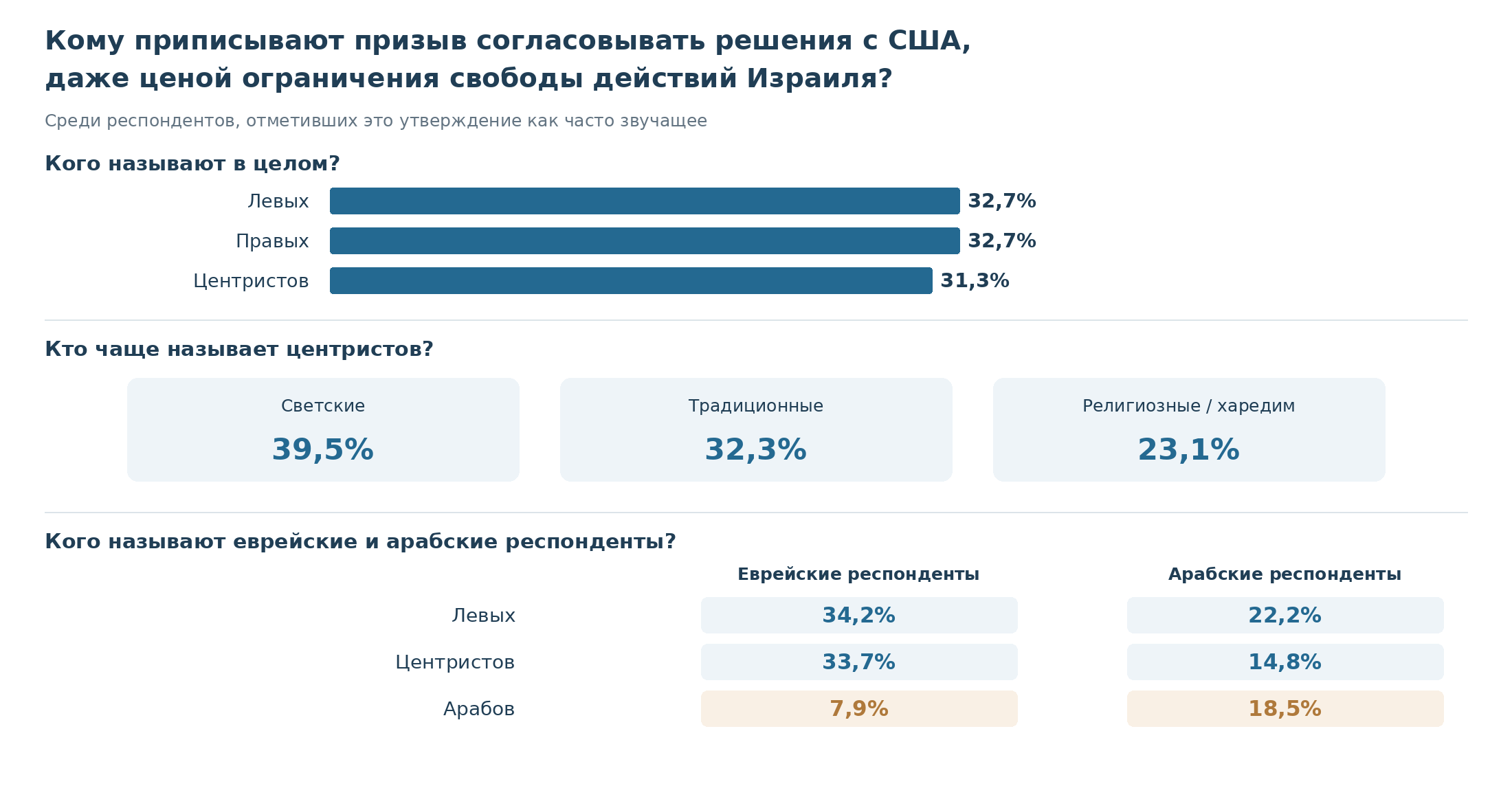
The claim that Israel should coordinate its decisions with the United States has no clear political home. Respondents name the left and the right equally often (32.7% each), and the center almost as often (31.3%). Secular respondents most often name the center (39.5%), traditional respondents the right (38.5%), and religious and Haredi respondents the left (38.5%).
Jewish respondents name the left, the center, and the right at about the same rate (34.2%, 33.7%, and 32.1%). Arab respondents most often name the right (37.0%).
14. Who is associated with the claim about double standards?
Table 14. Which groups most often make the following claim? "Western countries judge Israel by a different standard than other countries at war" Base: 292 respondents. Multiple responses allowed; percentages may sum to more than 100%. Asked only of respondents who selected this claim in question 7.
Which groups are named by respondents of different religiosity?
| Secular | Traditional | Religious / Haredi | |
|---|---|---|---|
| The right | Secular53.6% | Traditional42.3% | Religious / Haredi73.7% |
| Religious Israelis | Secular29.3% | Traditional26.9% | Religious / Haredi45.6% |
Rows: groups named. Columns: respondents answering. Base: Secular N=140 · Traditional N=78 · Religious / Haredi N=57
Which groups are named by Jewish and Arab respondents?
| Jewish respondents | Arab respondents | |
|---|---|---|
| The center | Jewish respondents33.8% | Arab respondents5.9% |
| Secular Israelis | Jewish respondents28.7% | Arab respondents17.6% |
| The left | Jewish respondents25.1% | Arab respondents11.8% |
| Haredim | Jewish respondents9.5% | Arab respondents23.5% |
Rows: groups named. Columns: respondents answering. Base: Jewish respondents N=275 · Arab respondents N=17
Full table by respondent group
| Response | All respondents | Secular | Traditional | Religious / Haredi | Jewish | Arab |
|---|---|---|---|---|---|---|
| The right | 53.8% | 53.6% | 42.3% | 73.7% | 54.5% | 41.2% |
| The center | 32.2% | 35.7% | 34.6% | 28.1% | 33.8% | 5.9% |
| Religious Israelis | 31.8% | 29.3% | 26.9% | 45.6% | 32.0% | 29.4% |
| Secular Israelis | 28.1% | 28.6% | 34.6% | 21.1% | 28.7% | 17.6% |
| The left | 24.3% | 26.4% | 26.9% | 19.3% | 25.1% | 11.8% |
| Haredim | 10.3% | 9.3% | 3.8% | 17.5% | 9.5% | 23.5% |
| Israeli Arabs | 9.2% | 7.9% | 14.1% | 5.3% | 9.1% | 11.8% |
| All groups | 17.8% | 22.9% | 15.4% | 8.8% | 17.8% | 17.6% |
| None of these groups | 1.0% | 0.7% | 0.0% | 0.0% | 0.4% | 11.8% |
| Don't know | 7.2% | 7.1% | 9.0% | 3.5% | 6.9% | 11.8% |
| Total | 215.8% | 221.4% | 207.7% | 222.8% | 217.8% | 182.4% |
| N | 292 | 140 | 78 | 57 | 275 | 17 |
Original figures in Russian
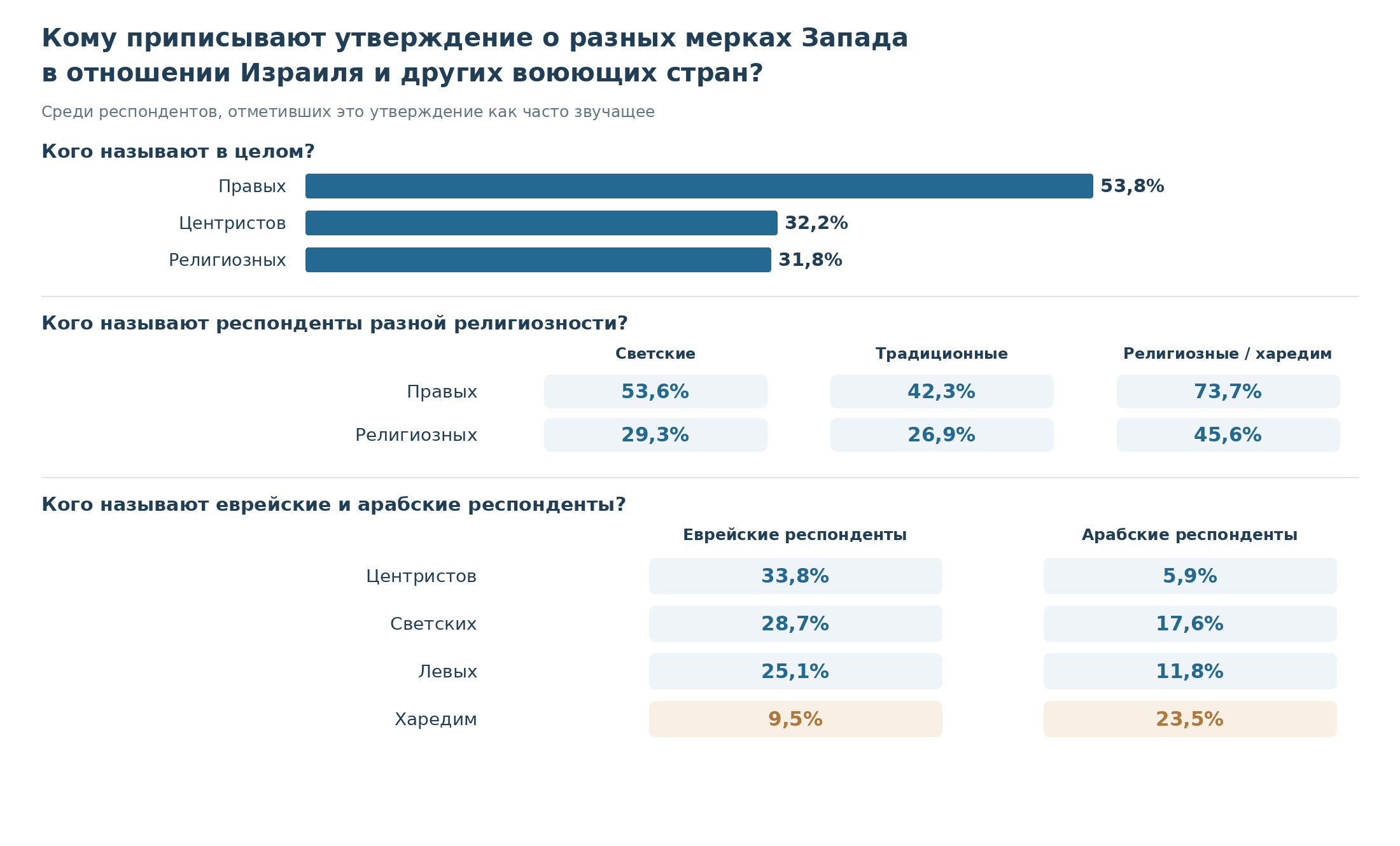
Respondents most often attribute the claim about Western double standards to the right (53.8%), followed by the center (32.2%) and religious Israelis (31.8%). Religious and Haredi respondents link it to the right especially often (73.7%, vs. 53.6% of secular and 42.3% of traditional respondents).
The right leads among both Jewish and Arab respondents (54.5% and 41.2%). Second place differs. Jewish respondents name the center (33.8%), while Arab respondents name religious Israelis (29.4%).
How respondents perceive social groups
The data outline how respondents perceive different groups in Israeli society. The chart below shows the four groups respondents most often linked to the claims tested.
Perceived social group profiles
The left
- Limiting operations in Gaza
- Government military and foreign-policy decisions to retain power
- Criticizing the government even during wartime
- International pressure linked to the unresolved Palestinian issue
The right
- A foreign policy as independent as possible from U.S. and European positions
- Western double standards toward Israel and other countries at war
The center
- Government military and foreign-policy decisions to retain power
- Criticizing the government even during wartime
Less clear-cut attribution; themes shared with the left.
Arab citizens of Israel
- Limiting operations in Gaza because of harm to civilians
- International pressure linked to the unresolved Palestinian issue
Original diagram in Russian
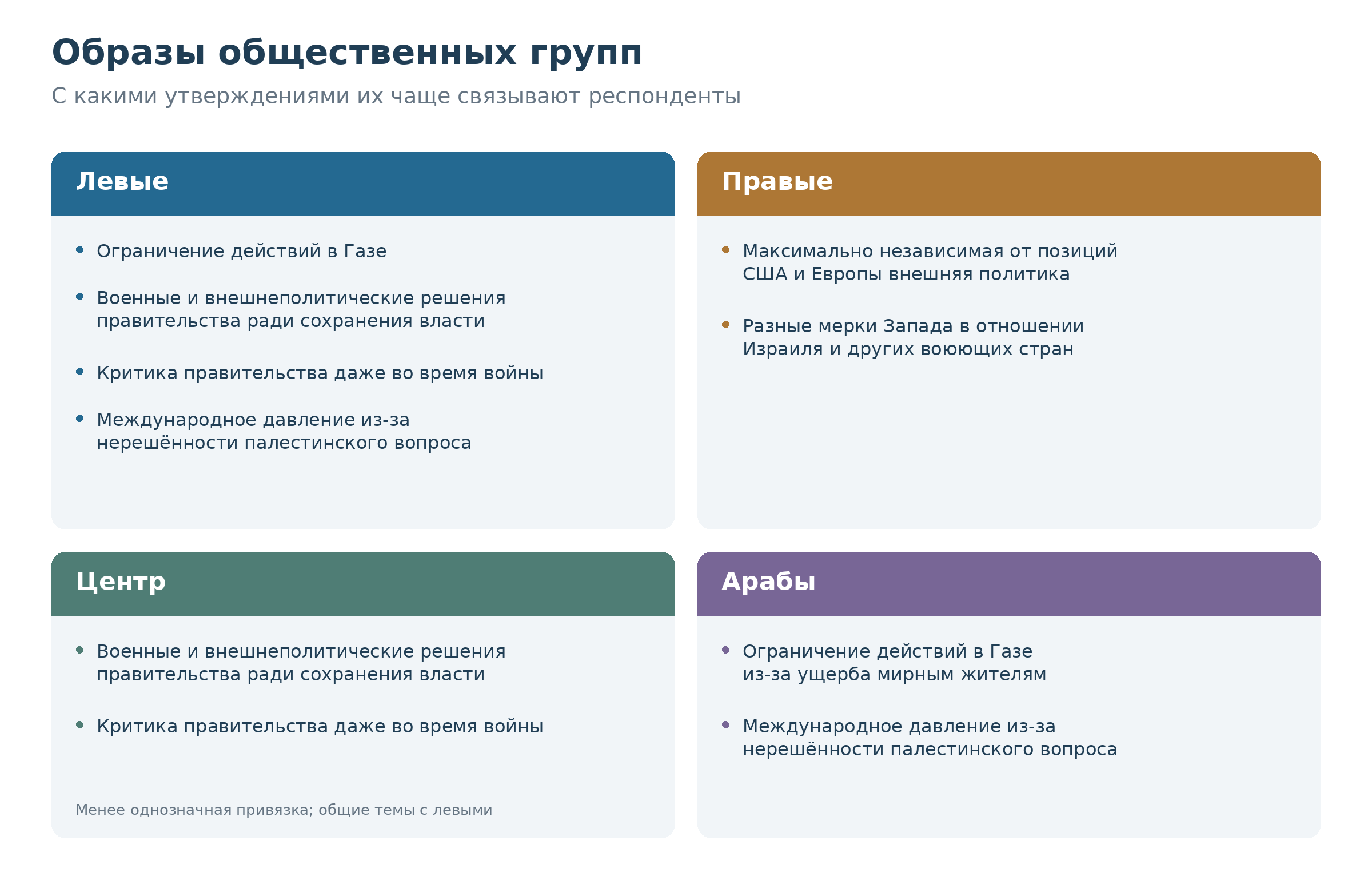
Respondents tend to associate the left, the center, and Arab citizens of Israel with criticism of the government and its actions, though the content and intensity of these associations differ. They associate the right with an independent foreign policy and with criticism of Western double standards toward Israel. Respondents link centrists to the claim that the government should be criticized even in wartime and to the claim that its military and foreign policy decisions are driven by a desire to stay in power. On these themes, the image of the center resembles that of the left but is less sharply defined. Arab citizens of Israel are seen above all as holders of two claims. One holds that Israel's operations in Gaza cause excessive harm to civilians. The other ties international pressure on Israel to the unresolved Palestinian issue. Their image centers on the conflict's toll on civilians and on the Palestinian question.
Sources and research materials
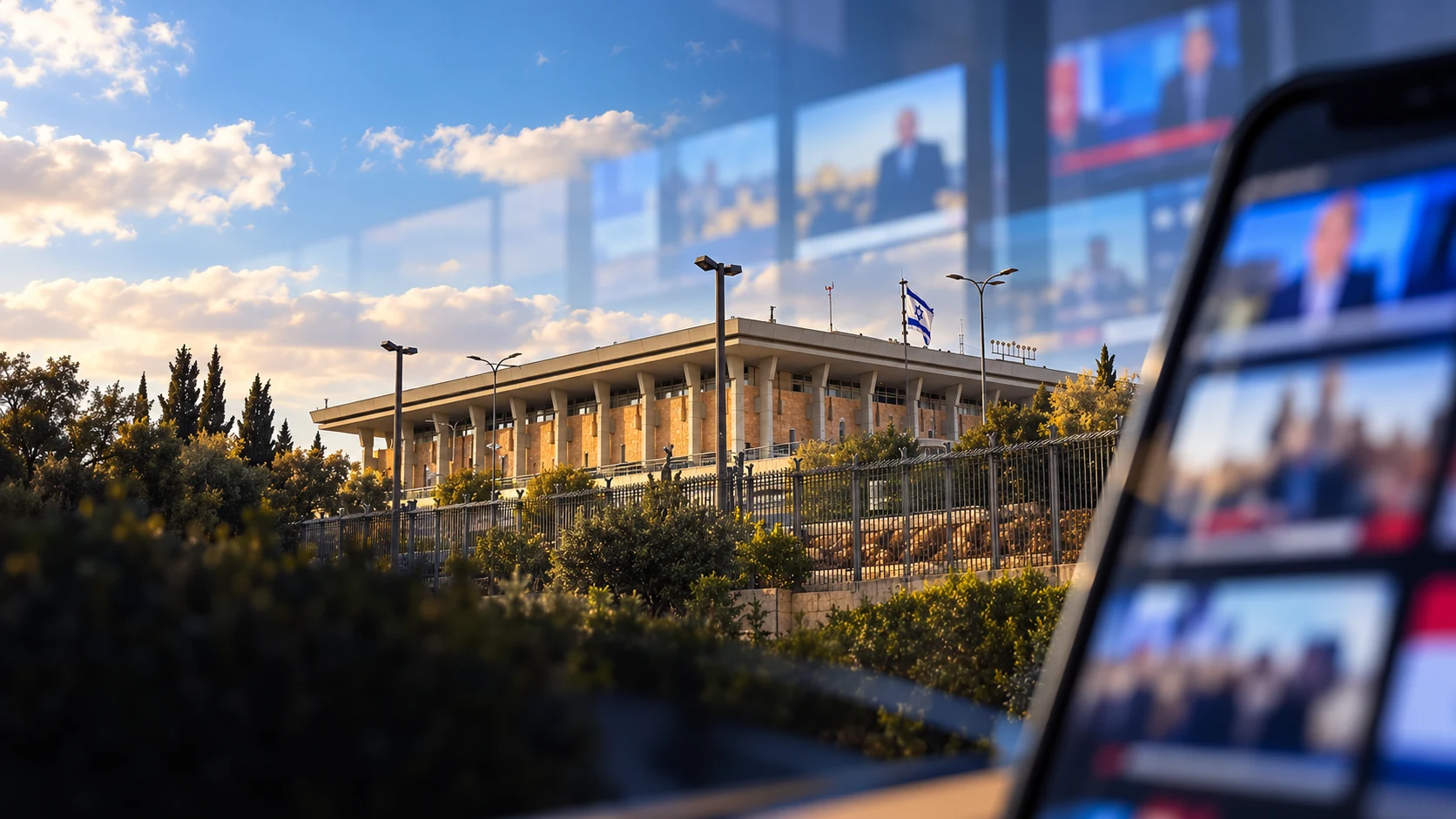
Data source: “Perceptions of Foreign Information Influence and Media Discourse in Israeli Society”, a Haifa Format project study with the Geocartography Knowledge Group, October 2026. All 14 tables are published, including “don’t know” responses, totals and subgroup sample sizes N. Photographic basis of the cover: Fallaner, Knesset, 25 November 2018. Adapted into an editorial illustration; it is not a documentary photograph of an event. The illustration is available under CC BY-SA 4.0. Wikimedia Commons · CC BY-SA 4.0