
 Global connections
 Research & archive







Historical material. Dates, proposals and invitations refer to the time of the original publication.
Belief in the need for change
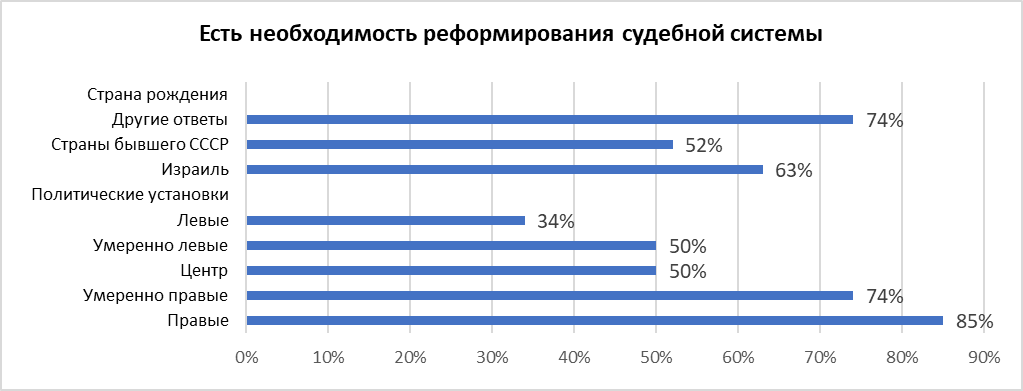
63% of the population are convinced of the need for legal reform; among those who have an opinion on the matter, the figure is 72%. (Table 2) Respondents born in the former USSR are less likely than others to report such a need (52%, compared with 63% and 74% among those born in Israel and other countries, respectively). They are also more likely to say that they do not know the answer (19%, compared with 12% and 6%, respectively). (Table 2.1, Chart 2)
- In general, do you think there is a need for any reform of the Israeli legal system, or not?
| Among those expressing an opinion | Full sample | Response options |
|---|---|---|
| 72% | 63% | There is a need |
| 28% | 25% | There is no need |
| — | 12% | Do not know |
| 100% | 100% | Total |
There is a trend towards stronger demands for judicial reform from the far left to the far right. The Pearson correlation coefficient (-0,94) between political orientation (from right to left) and assessments of the need for judicial reform indicates a strong negative linear relationship between these variables. As political orientation moves from right to left, the share of respondents who believe judicial reform is necessary decreases, while the share who believe it is unnecessary increases. The correlation coefficient of -0,94 indicates that this relationship is strong and statistically significant.
Russian speakers and legal-system reform
It is also noteworthy that those born in the former USSR are less likely than others to see a need for reform (52% agree, compared with 63% and 74% of those born in Israel and other countries), more likely to say that reform is unnecessary (29%, compared with 25% and 20%, respectively), and more likely than others to find it difficult to answer (19%, compared with 12% and 6%, respectively). Given the lowest index of interest in judicial reform in this group (see Table 1.1 above), the finding of the lowest awareness of the subject appears quite logical.
2.1. Distribution of responses on the need for legal reform (by age, country of birth and political orientation):
| Total | Do not know | There is no need | There is a need | Age |
|---|---|---|---|---|
| 100% | 14% | 18% | 68% | 17-30 |
| 100% | 16% | 26% | 58% | 31-49 |
| 100% | 9% | 30% | 61% | 50-64 |
| 100% | 5% | 28% | 67% | 65+ |
| Country of birth | ||||
| 100% | 12% | 25% | 63% | Israel |
| 100% | 19% | 29% | 52% | Former USSR countries |
| 100% | 6% | 20% | 74% | Other responses |
| Political orientation | ||||
| 100% | 7% | 8% | 85% | Right |
| 100% | 10% | 16% | 74% | Moderate right |
| 100% | 15% | 35% | 50% | Centre |
| 100% | 15% | 35% | 50% | Moderate left |
| 100% | 16% | 50% | 34% | Left |
| 100% | 36% | 42% | 22% | Other |
Need for reform by country of birth
| Israel | 63% |
|---|---|
| Former USSR countries | 52% |
| Other countries | 74% |
Need for reform by political orientation
| Right | 85% |
|---|---|
| Moderate right | 74% |
| Centre | 50% |
| Moderate left | 50% |
| Left | 34% |