

 Global connections
 Research & archive







Historical material. Dates, proposals and invitations refer to the time of the original publication.
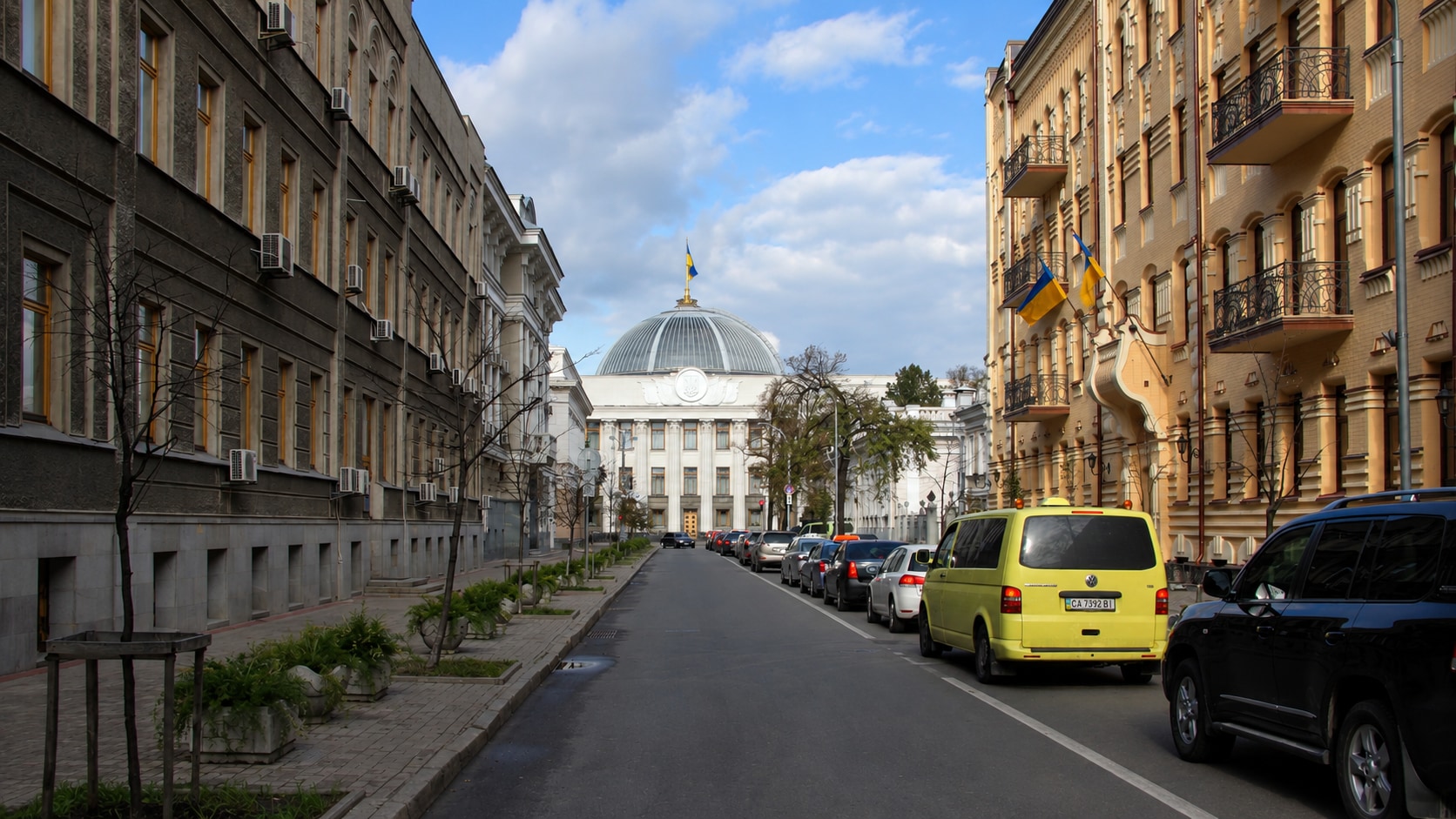
Cover photograph: Wadco2, 2013 · original photograph · License CC BY-SA 3.0. Framing adapted with AI; this is a processed version, with the original photograph retained separately.

Instead of an introduction: they meant well
In recent years, Ukraine's political situation has followed the most negative scenario. Yanukovych may have financed nationalists to replay Boris Yeltsin's electoral contest with the communists under the slogan 'Vote or lose', but nobody expected those nationalist groups to lead the Maidan protests.
The association agreement with the EU was not signed immediately, but public indignation could have led to a peaceful transfer of power and early elections, as in Armenia in 2018, which, incidentally, has agreements with both the European Union and the Eurasian Economic Union. Something went wrong, however: nationalist groups radicalized the protests, and the situation deteriorated into civil conflict.
Ukrainian think tanks and nongovernmental organizations may have been financed by foreign governments and financial speculators promoting neoliberal ideology. But democratic institutions could still have been used to reform social services, health care and education in line with domestic interests in developing human capital. Instead, the Reanimation Package of Reforms emerged, and neoliberal reforms aimed at destroying social infrastructure became irreversible.
We see the same negative scenario in language policy, deindustrialization, foreign policy and many other areas of government and social relations.
Ukraine is again entering an election period. The presidential election is about a year away and the parliamentary election a year and a half away. The new elections will apparently not be early, but, as always, they will mark a turning point for the country, perhaps as decisive as the extraordinary presidential and parliamentary elections of 2014. Many factors have converged that could make the transfer of power in Ukraine in 2019 follow the most negative scenario: the emergence of a dictatorship and entry into what Emilio Oscar Rabasa called a latent revolutionary situation, in which today's revolutionaries become tomorrow's dictators.
Some theory and historical analogies: dictatorship and radical populism
The question of who might become the dictator matters, but there are objective circumstances that would force anyone taking power in the country now to become a harsh authoritarian leader with dictatorial powers.
The twentieth century provided enough examples to study how authoritarian regimes emerge and what their rule produces. These include Juan Perón, president of Argentina in 1946–1955 and 1973–1974; Sukarno, president of Indonesia in 1945–1967; Gamal Abdel Nasser, president of Egypt in 1956–1970; Muammar Gaddafi, Libya's leader in 1969–2011; Saddam Hussein, president of Iraq in 1979–2003; and Hosni Mubarak, president of Egypt in 1981–2011.
Some researchers, including A. P. Safronov in Radical Populism and Mobilizational Participation, distinguish three forms of contemporary populist practice:
Three forms of populism in the author’s classification
Autonomous and personal
A leader with a group of associates addresses the masses personally and pursues individual objectives without directly representing a class or collective interest. The leader does not establish a new regime, but strengthens personal power and that of close associates, as with Silvio Berlusconi and Lech Kaczyński. Erdoğan in Turkey and other politicians regularly called populists by liberal circles worldwide can also be included. Leonid Kuchma and both Viktors, Yushchenko and Yanukovych, played this role. This was the principal form through which Ukrainian presidents exercised power.
Coalitional, or national-reformist
The essence of this form is that elites act as subjects and the masses as objects of populist influence. Elite groups and their coalitions engage with the public. They do not seek to establish authoritarianism. They initiate and imitate sweeping reforms to strengthen the new coalition's powers. This form can also be called national-reformist. The rule of Poroshenko, Yatsenyuk, Avakov, Turchynov and other elites after Yanukovych's overthrow fits this form closely. It is unstable, however, and tends toward radicalization.
Radical and institutional
The subject exercising populist influence is a powerful alliance of a bourgeois-nationalist group formed amid civil conflict and confrontation. Its objective is to establish an authoritarian regime in order to: — stabilize the sociopolitical system; — assimilate and/or marginalize competing groups; — eliminate radical groups seeking to blow up the system.
Every country that moved toward radical-institutional populism had experienced systemic stagnation that grew into uncontrolled collapse.
Several preconditions suggest that radical-institutional populism could be applied as a political technique in Ukraine:
- The presence of a radical-nationalist elite group opposing outside influence. Large oligarchs, bureaucrats and landowners would evidently swear loyalty to a dictator to preserve their businesses and their lives;
- The impoverishment of the population;
- Catastrophic dependence on imports;
- The state's abandonment of paternalism and of addressing acute social problems;
- Uncontrolled civic activism and the destruction of traditional ties and social institutions;
- Systemic crisis and the emergence of fanatics on both the left and right seeking to replace the political order and the elites.
Another important factor is Ukraine's position as an object of geopolitical processes, including the possibility that the United States and Russia could reach agreements about its future without Ukrainian representatives participating.
A historical analogy can also be proposed. The entire period of independent Ukraine from Kravchuk to Poroshenko fits the 4 periods described in Volodymyr Vynnychenko's Rebirth of a Nation:
1. The Central Rada period. Its driving force was the whole conscious national democracy, without class distinctions. Vynnychenko divides it into two subperiods: a) revolutionary organization of statehood and moral-legal authority. This corresponds, of course, to Leonid Kravchuk's period, with its joys of independence and transition from the Ukrainian SSR to Ukraine.
b) Legal and constitutional statehood. This corresponds to Leonid Kuchma's period: adoption of the Constitution, construction of state hierarchies, struggles with clans and the pursuit of economic growth.
2. The Hetmanate period, according to Vynnychenko, is defined by the dominant role of bourgeois and reactionary classes. In independent Ukraine it was represented by Yushchenko and Yanukovych, two parochial regional leaders from western and southeastern Ukraine.
3. The Directory period transfers the leading role to the revolutionary classes: the national rural and urban proletariat. Its counterpart is the nationalist Maidan of 2014 and the first-round transfer of power to Petro Poroshenko.
Following this model, we are moving toward period 4, the age of the atamans: military rule representing the petty national bourgeoisie ideologically and being autocratic in substance.
The completeness of the historical analogy is clearly debatable, but the model helps anticipate possible developments at Ukraine's next historical turning point.
The New Course and everyone else: the roots of Tymoshenko's radical populism
On 12 July 2018, the Rating sociological group published a survey conducted from 22 June to 5 July 2018 among Ukrainian residents aged 18 and over. Yulia Tymoshenko led the presidential poll, supported by 17.1% of those intending to vote who had already decided on a candidate. Anatoliy Hrytsenko received 9.7%, and Petro Poroshenko 7.8%.
The second-choice ranking was led by Sviatoslav Vakarchuk at 5.3%, Yulia Tymoshenko at 4.9%, Volodymyr Zelenskyy at 4.7% and Hrytsenko at 4.7%.
Poroshenko led the rejection ranking: almost half of respondents would not vote for him under any circumstances.
These figures suggest that Petro Poroshenko's chances of legally winning a second presidential term are extremely small. The arrival in power of his main rival, Yulia Tymoshenko, threatens him with serious problems, even regarding his physical survival.
The turning point of 2014 placed Poroshenko in the presidential chair in a single round. Expectations of radical change and a complete reset along European and North Atlantic lines produced Strategy 2020, presented by Poroshenko in 2014. It envisaged 60 reforms intended to lead Ukraine toward EU and NATO membership. Strategy 2020 was compounded by decentralization reforms and implementation of the EU-Ukraine Association Agreement. In practice, in 2018 we see economic decline, impoverishment, loss of territory, worsening relations with European neighbors, and decentralization producing centrifugal tendencies in several regions amid difficult economic conditions.
Now, before another election, the public demands another reset. Following Yanukovych's slogans 'Building a new country' and 'I will hear everyone', and Poroshenko's 'A new way of living', Yulia Tymoshenko held her New Course of Ukraine forum on 15 June 2018, promising new opportunities for everyone.
The forum brought together active reformers, both politicians and civic figures, whose efforts had turned Ukraine's destructive reforms into instruments of external control since 2014.
Much has been written about why Tymoshenko's announced process of creating a new social contract, drafting a new constitution and intensifying the fight against corruption cannot be delivered, becoming instead instruments of populist influence over the masses.
Several difficulties would evidently prevent Tymoshenko from implementing the New Course in its pastoral vision of social synergy and would force her to employ populist techniques:
- the complexity of the socioeconomic and political problems faced by the social groups targeted by populist influence. Finding the necessary, perhaps radical solutions often requires moving beyond the existing socioeconomic system;
- politicians' embeddedness in the structures and systems that created the problems they or their parties promise to solve. Institutional inertia, and often the need to reconfigure the system itself, prevents the development of real solutions and concrete implementation processes;
- the absence of practical solutions, given the preceding factors, creates a need to replace specific mechanisms with emotional imagery to sustain mobilization. These images usually relate to a social group's basic needs, fears and myths;
- when practical solutions are absent, politicians must intensify conflicts over values to provide emotional satisfaction for the public;
- conflict over values, as a form of show business, requires a continual increase in emotional intensity through more radical imagery and its associated meanings.
The voice of the people is the voice of the dictator
When considering what a Tymoshenko presidential victory would bring to Ukraine and whether she would become a harsh authoritarian leader, another important point must be considered: a particular cognitive dissonance among Ukrainian voters. A Rating Group survey conducted from 14 to 24 June 2018 found significant differences between what Ukrainians considered important for the country and what mattered to them personally.
The same issues, two different questions
| Issue | Important for the country | Important personally |
|---|---|---|
| Military conflict in eastern Ukraine | 78% | 22% |
| Bribery and corruption in government | 55% | 15% |
Percentage of respondents. Rating, 14–24 June 2018, sample 2,500. Up to three answers were allowed for each question; percentages do not add up to 100%.
The most frequent personal priorities
| Rising prices and inflation | 54% |
|---|---|
| Rising utility charges | 54% |
| Low wages and pensions | 51% |
Ukrainians are least concerned about the status of the Russian language in Ukraine, at 2%, and relations with the European Union, at 4%.
This phenomenon can be explained in different ways: brainwashing, the narrow circle benefiting from the conflict in the east and anti-corruption activity, or a practical Ukrainian mentality expressed in the sayings that one's own shirt is closest to the body and one's house stands apart. That is not especially important. What matters is that Tymoshenko would have to replace the reformers' agenda associated with the previous turning point, and the ideologues and implementers of the Poroshenko-era reforms would have to disappear with it.
Thus, while Poroshenko offers continuity of existing trends and the principal political and economic actors, Tymoshenko brings retaliation, revenge and a radical redistribution of property.
The public demands radical action against politicians and reformers. In recent days, an outraged public has physically confronted Petro Poroshenko's son, parliamentarian Viktor Pynzenyk and, most tellingly, Maidan hero and current parliamentarian 'Cossack Havryliuk'.
Tymoshenko's arrival in power would enable her to obtain unlimited dictatorial powers to fight the enemies of Batkivshchyna, meaning Fatherland, thereby fulfilling another of her campaign slogans: 'She is Ukraine'.
A Tymoshenko dictatorship would pose a mortal danger to most incumbent politicians and presidential candidates. Fear of her and her dictatorial potential could unite Poroshenko, Yatsenyuk and other political heavyweights.
This raises the possibility that, as the election approaches and conditions deteriorate, some political actors might seek to remove Yulia Volodymyrivna from the race. How might they do it? The question remains open, but the wait will not be long.
If we follow the initial premise that every turning point in Ukraine takes the most negative course, a Ukrainian dictatorship is not far away.
Igor Kaminnik for iines.org