
 Global connections
 Research & archive








Historical material. Dates, proposals and invitations refer to the time of the original publication.
Israel’s preferred position
There is a lack of any consensus regarding the idea of Israel’s ideal position in the geopolitical coordinates.
Israel’s preferred position
| Neutrality and relations with both sides | 35.8% |
|---|---|
| Decisions for specific situations | 22.2% |
| Side with the Collective West | 19% |
| Side with the Global South | 3.2% |
| None of these | 4% |
| Don’t know | 15.8% |
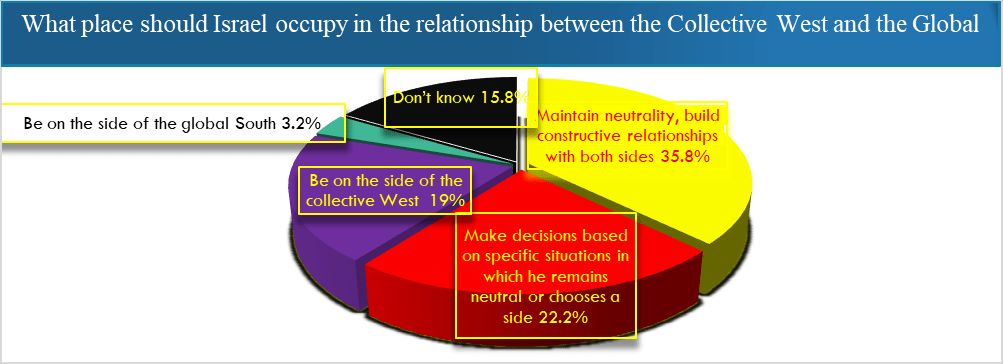
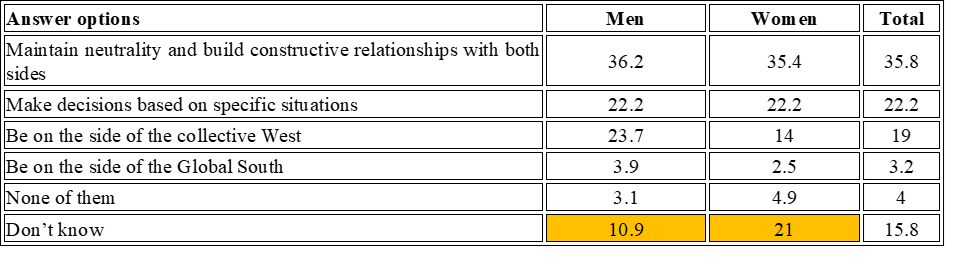
The majority of respondents (35.8%), both men (36.2%) and women (35.4%), consider it preferable for Israel to maintain neutrality and build constructive relationships with both the Collective West and the Global South. The second most significant options are «Decisions should be made depending on specific situations and areas where Israel maintains neutrality or chooses a side» (22%) and «To side with the Collective West» (19%). There is a notable difference in the preferences of men and women regarding siding with the Collective West. This position is supported by 23.7% of men, while among women, this figure is significantly lower at 14%.
Only 3.2% of respondents believe that Israel should be on the side with the Global South—a value within the margin of statistical error, similar to the option «None of these options» (4%). This is likely to be viewed not so much as a negative attitude toward this position, but rather as an indication that this option is not generally considered a viable choice.
Table 4. In your opinion, what position should Israel take in the relations between the Collective West and the Global South? % / overall distribution, gender
| Response | Men | Women | All respondents |
|---|---|---|---|
| Neutrality and relations with both sides | 36.2% | 35.4% | 35.8% |
| Decisions for specific situations | 22.2% | 22.2% | 22.2% |
| Side with the Collective West | 23.7% | 14% | 19% |
| Side with the Global South | 3.9% | 2.5% | 3.2% |
| None of these | 3.1% | 4.9% | 4% |
| Don’t know | 10.9% | 21% | 15.8% |
Age and neutrality
As age increases, Israelis show a growing preference for neutrality and constructive relationships with both sides, as indicated by the Pearson correlation coefficient (r), which reflects an almost perfect positive relationship between these variables (r = 0.99).
Neutrality by age
| 18–34 | 29.1% |
|---|---|
| 35–54 | 38.1% |
| 55+ | 47.7% |
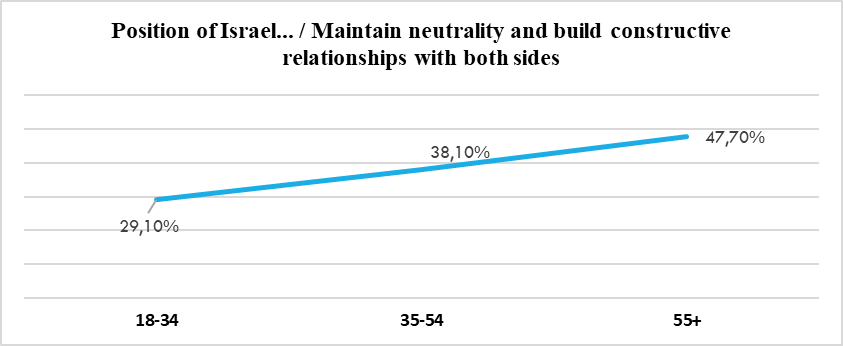
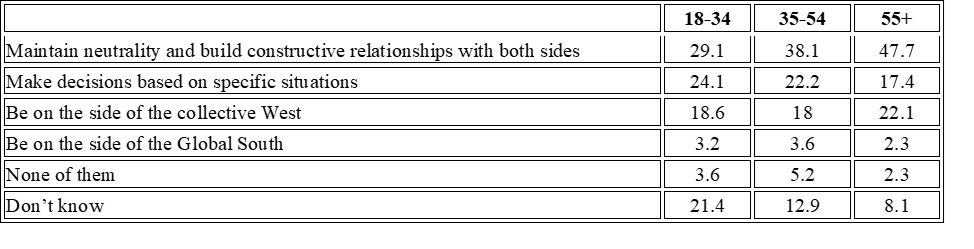
Between age groups and the response «Make decisions based on specific situations,» there is also a strong, statistically significant but negative correlation (r = -0.97), indicating that with increasing age, the tendency to make situational decisions decreases, while the inclination towards siding with the Collective West strengthens. The positive correlation between the latter option and increasing age is r = 0.79. For the option «To side with the Global South,» the values fall within the margin of statistical error and are not indicative.
Table 4.1. In your opinion, what position should Israel take in the relations between the Collective West and the Global South? % / age
| Response | 18–34 | 35–54 | 55+ |
|---|---|---|---|
| Neutrality and relations with both sides | 29.1% | 38.1% | 47.7% |
| Decisions for specific situations | 24.1% | 22.2% | 17.4% |
| Side with the Collective West | 18.6% | 18% | 22.1% |
| Side with the Global South | 3.2% | 3.6% | 2.3% |
| None of these | 3.6% | 5.2% | 2.3% |
| Don’t know | 21.4% | 12.9% | 8.1% |
Religiosity and choosing a side
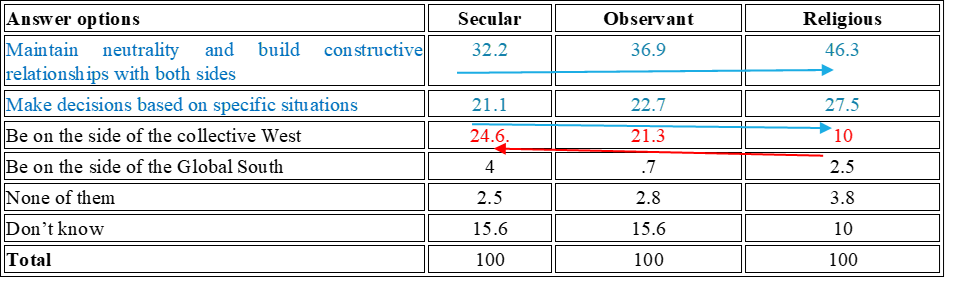
There is also a statistically significant positive correlation between the positions «Maintain neutrality and build constructive relationships with both sides» (r = 0.98), «Make decisions based on specific situations,» and the degree of religiosity (r = 0.96). Conversely, as the degree of religiosity decreases, the inclination towards siding with the Collective West increases (r = -0.95).
Neutrality by religiosity
| Secular | 32.2% |
|---|---|
| Observant | 36.9% |
| Religious | 46.3% |
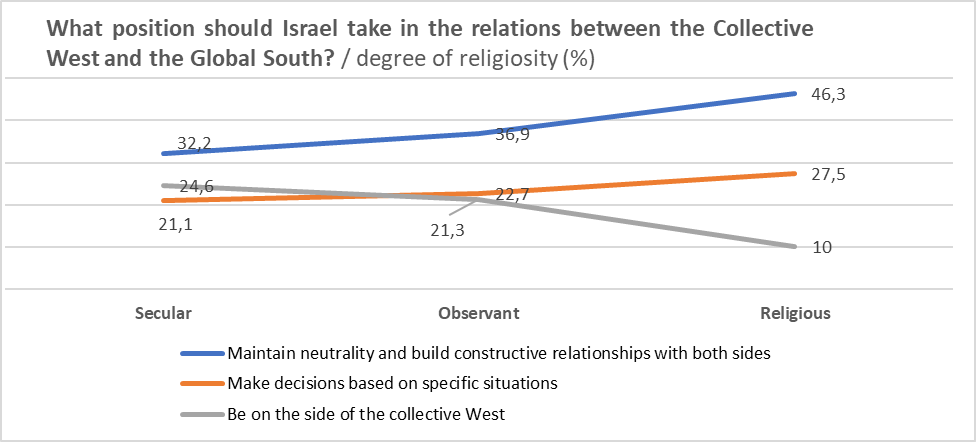
Table 4.2. What position should Israel take in the relations between the Collective West and the Global South? %
| Response | Secular | Observant | Religious |
|---|---|---|---|
| Neutrality and relations with both sides | 32.2% | 36.9% | 46.3% |
| Decisions for specific situations | 21.1% | 22.7% | 27.5% |
| Side with the Collective West | 24.6% | 21.3% | 10% |
| Side with the Global South | 4% | 0.7% | 2.5% |
| None of these | 2.5% | 2.8% | 3.8% |
| Don’t know | 15.6% | 15.6% | 10% |