 Global connections
 Research & archive



Historical material. Dates, proposals and invitations refer to the time of the original publication.
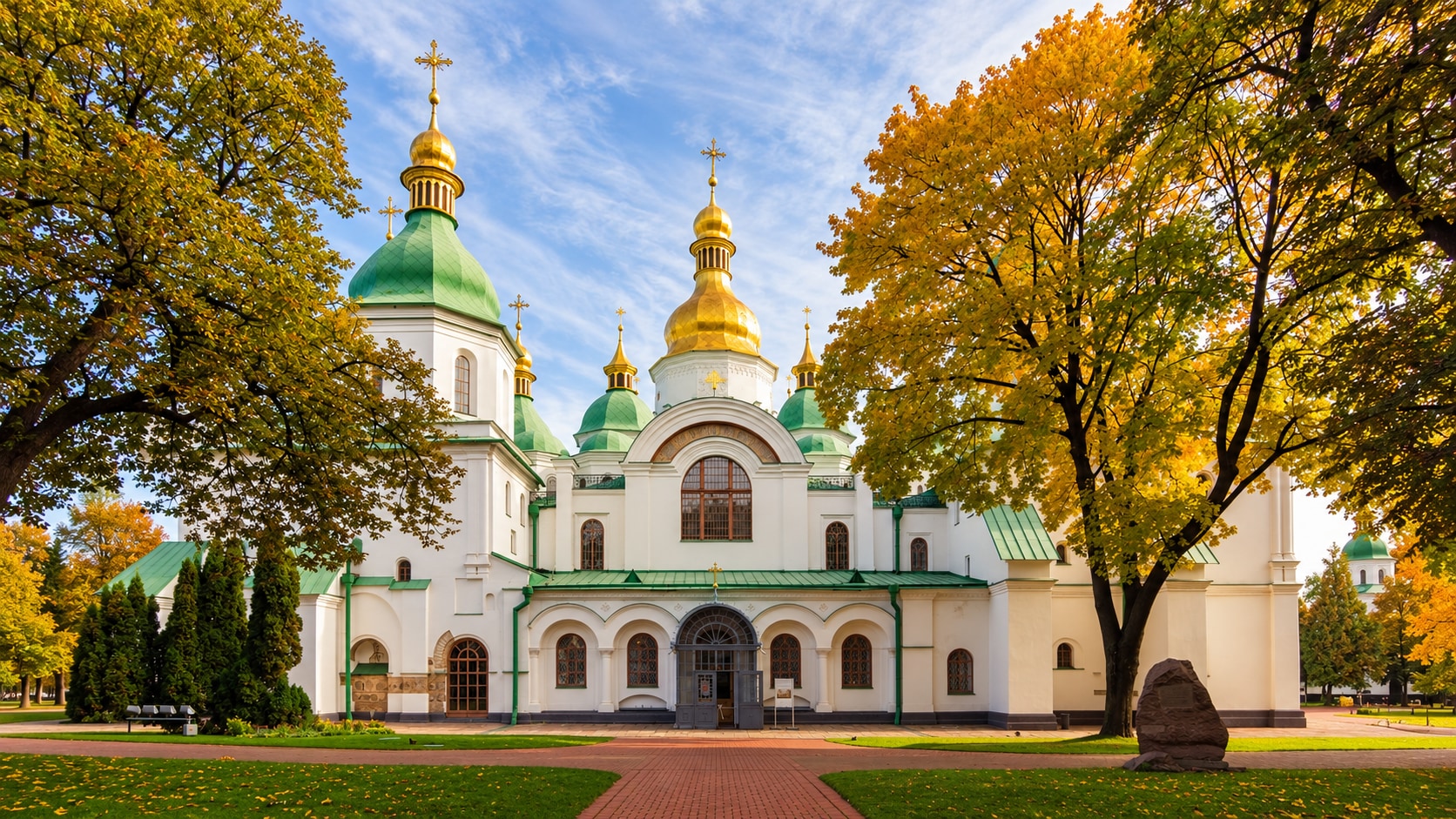
Cover photograph: Rbrechko, 2017 · original photograph · License CC BY-SA 4.0. Framing adapted with AI; this is a processed version, with the original photograph retained separately.

Exactly 10 years ago, in September 2008, we published our article Ukraine: Together We Are Many, describing trends that, 10 years later, brought catastrophic consequences for Ukraine.
Here are a few quotations:
'…Even Ukraine's most ingenious enemy could not have done as much to destroy Ukrainian statehood as Viktor Andriyovych did. He managed to divide the country clearly into two virtually irreconcilable parts. …The operation to divide it along religious lines could be called masterful. …Filaret, several autocephalists, Greek Catholics and Catholics headed by the pope on one side, and the Russian Orthodox Church on the other…'
The tomos and the political context
The granting of a tomos, a decree of autocephaly for the Orthodox Church in Ukraine, by Patriarch Bartholomew I of Constantinople is, in the Ukrainian authorities' view, a logical continuation of political Ukrainianism's longstanding efforts to create an anti-Russian and, strange as it may sound, anti-Orthodox Ukraine.
As Poroshenko told the Verkhovna Rada on 19 April 2018: 'This is not only religion; it is geopolitics. For me, establishing an independent local church carries the same weight as visa-free travel, the Association Agreement and our common struggle for membership in the European Union and NATO. It is a matter of national security and defense in this hybrid war, because the Kremlin regards the Russian Church as one of its main instruments of influence over Ukraine.'
In other words, the stated objective of pushing the canonical Ukrainian Orthodox Church out of Ukraine has been voiced by the secular authorities and supported by Bartholomew I.
The ideological and theological battles over the tomos place the Russian-Ukrainian confrontation not in the realities of the twenty-first century but in those of medieval religious wars and political games on Ukrainian territory.
For political Ukrainians, especially those from western Ukraine whose spiritual and religious foundation is the Ukrainian Greek Catholic Church, the tomos appears to be the logical culmination of a centuries-long struggle.
A struggle by the European religion of enlightened Europe, Catholicism, against Russian Orthodoxy as the religion of eastern despotism, the Russian Empire and modern Russia. It is no coincidence that on 21 August 2005, when the Ukrainian Greek Catholic Church transferred its center from Lviv to Kyiv, Cardinal Husar declared that darkness would disperse over Kyiv and the sun of Christ's truth would rise in unity with the pope.
The 10-year anniversary mentioned at the beginning is therefore only an instant in a centuries-long struggle in which victories in war become defeats in peacetime and rational approaches lose to fanaticism.
Ukraine's pursuit of the tomos can be seen as a dramatic continuation of a millennial spiritual and political struggle between different religious and imperial formations.
Primacy and power
Several aspects can be distinguished in this game of thrones, in which the people of Russia and Ukraine have become participants.
The Patriarchate of Constantinople's claim to primacy in the Orthodox world, and its primate's claim to the role of a pope of the eastern rite under the title 'His Divine All-Holiness, Archbishop of Constantinople, New Rome, and Ecumenical Patriarch', have continued for centuries. Originally these claims were explained by Constantinople's position as the center of the Byzantine Empire and stronghold of eastern Christians.
However, after the Union of Lyon in 1274, when Patriarch John XI Bekkos agreed to unite the churches under papal authority, and the Union of Florence signed in 1439 under pressure from Byzantine Emperor John VIII Palaiologos and Patriarch Joseph II, Constantinople's claims to leadership of the Eastern Church lost their foundation.
After 29 May 1453, when Sultan Mehmed II captured Constantinople and the Byzantine Empire fell, the claims associated with the Second Rome likewise disappeared.
Bartholomew I is now a Turkish citizen and, under a Turkish court ruling of 2005 upheld on appeal in 2007, cannot call himself Ecumenical Patriarch. In Turkey his status is that of head of the country's Greek Orthodox community.
The desire to establish sole authority and replace the Orthodox formula governing relations among canonical churches, 'first among equals', with the Latin formula of unconditional papal supremacy determines the logic of Bartholomew's actions. This explains his statement at the Synaxis, the assembly of bishops held in Istanbul in early September 2018, that Constantinople has exclusive rights to resolve problems throughout the Orthodox world and can act unilaterally without consensus among the canonical Orthodox churches.
External actors and ecumenism
Much has been said about the United States' role in the Ukrainian schism. Yet the confrontation between Constantinople and Moscow began before the United States existed and will continue after it is gone. One might suggest that Bartholomew exploited heightened Russophobia and stronger anti-Russian sanctions, rather than being forced by Americans to violate church canons. Numerous articles discuss alleged ties between the CIA and Bartholomew: for example, in 2016 Turkish authorities accused him, after he left Turkey hours before the coup attempt, of connections to the CIA and opposition Islamic preacher Fethullah Gülen.
American officials do not conceal their aim of creating a unified autocephalous Ukrainian Orthodox Church. Ambassador-at-Large for International Religious Freedom Samuel Brownback said so at a meeting with President Petro Poroshenko on 11 September 2018. Earlier in 2018 the same official visited Patriarch Bartholomew to discuss, among other issues, Ukrainian autocephaly. Both former and serving American ambassadors to Ukraine have actively lobbied for the tomos.
For example, on 17 April 2018, Ukrainian Greek Catholic Church head Sviatoslav Shevchuk expressed support for a local Ukrainian church during a meeting with US Ambassador Marie Yovanovitch. She also met Filaret and representatives of another noncanonical religious structure, the Ukrainian Autocephalous Orthodox Church. On 29 May 2018, Geoffrey Pyatt, the former ambassador to Ukraine, met Archbishop Ieronymos, primate of the Church of Greece, to discuss Ukraine.
Bartholomew also has powerful church lobbyists for Ukrainian autocephaly. His largest number of parishes is in the United States: 540. In addition, he has taken Ukrainian ethnic church structures under his protection:
- The Ukrainian Orthodox Church of Canada, under the Ecumenical Throne's jurisdiction since 1990, created on the basis of noncanonical Ukrainian autocephalism;
- The Ukrainian Orthodox Church of the USA.
Representatives of these ethnic church structures were appointed Bartholomew's exarchs in Ukraine to consolidate the schism within the canonical Ukrainian Orthodox Church.
Archbishop Daniel of Pamphilon from the United States and Bishop Hilarion of Edmonton from Canada fully embody the Russophobic attitudes traditionally strong in the Ukrainian diaspora in those countries.
The pursuit of closer relations with the Vatican, up to and including union, is an old Constantinopolitan tradition. The patriarchate has centuries of experience with unions with the Vatican.
When assessing Bartholomew's ecumenical efforts, one should remember that he studied at the Pontifical Oriental Institute in Rome from 1963 to 1968. He lectured at the Pontifical Gregorian University and holds a doctorate in theology from the Oriental Institute, with a dissertation on canon law. Pope Pius XI entrusted the institute's administration to the Jesuits in 1922, so Bartholomew fully absorbed their spirit and methods. After taking the Constantinopolitan throne in 1991, he naturally transformed his personal Vatican contacts into patriarchal policy.
In an interview with the Italian newspaper Il Foglio in 2003, the Constantinopolitan primate still supported the Russian Orthodox Church and criticized Vatican policy toward Russia. In later years, however, it seemed that he did little other than meet Pope Francis. Some examples: on 20 March 2013, Francis and Bartholomew I met at the Vatican, and the Ecumenical Patriarch attended the pope's inauguration. Another symbolic meeting took place on 25 May 2014 at Jerusalem's Church of the Holy Sepulchre. That same year, on 28–30 November, Bartholomew received the pope in Istanbul during his official visit.
A joint declaration on ecumenical and humanitarian cooperation among the heads of the Catholic Church, the Orthodox Church of Constantinople and the Church of Greece was signed on 16 April 2016 on the Greek island of Lesbos.
Ukraine also linked the two primates. On 27 November 2017, a joint service at the Vatican commemorated the Holodomor's victims and condemned the war in eastern Ukraine.
Tradition and jurisdiction
Supporting the tradition of church unions and ecumenism requires the Constantinopolitan patriarch to modernize Orthodoxy and monopolize the Phanar's authority over canonical Orthodox churches worldwide. These objectives began to be implemented at the September Synaxis.
We have already discussed the special role Bartholomew assigned to Constantinople. He also began modernizing Orthodoxy by permitting priests to marry for a second time. For now the decision applies only within his patriarchate, but as his papal ambitions grow, he will promote this and more radical innovations.
In contrast to the fraternal relationship with the Vatican, the entire history of relations between Moscow and Constantinople is one of Constantinople imposing union with Catholics or supporting schisms on Moscow's canonical territory.
The eastern papism of Constantinople did not begin with Bartholomew. The struggle of the simulacrum known as the Second Rome against the imperial center of the Third Rome, Moscow and the Russian Orthodox Church, has a long history.
In this confrontation, the Union of Florence is instructive. It was signed under pressure from Patriarch Joseph II in 1439. In 1441, Isidore, metropolitan of Kyiv and all Rus', who had accepted the union, was arrested in Moscow but later escaped.
A new metropolitan, Jonah, was elected in Moscow by a council of Russian bishops in 1448. The beginnings of an autocephalous Russian Orthodox Church were thus effectively provoked by the union initiated by Constantinople.
The Union of Brest was signed in 1596 between part of the Orthodox population of the Polish-Lithuanian Commonwealth, belonging to the metropolitanate of Kyiv, Galicia and all Rus' under Constantinople, and the Catholic Church. It created the Ruthenian Uniate Church, which came to be called the Ukrainian Greek Catholic Church in the early 20th century.
In 1620, Patriarch Theophanes III of Jerusalem consecrated a new metropolitan of Kyiv and all Rus' and bishops for other sees. The Orthodox metropolitanate of Kyiv was restored, and its metropolitans resumed the title metropolitan of Kyiv and all Rus'.
In May 1686, Moscow obtained Patriarch Dionysius IV's consent to place the Kyiv metropolitanate under the Moscow patriarch.
Interestingly, Bartholomew's accusations against Moscow at the September 2018 Synaxis begin in 1299, when Moscow supposedly began causing problems for the then 'absent' Constantinopolitan patriarchate. In 1686 it supposedly treacherously seized another church's canonical territory, which Constantinople had not managed to place under Rome. Constantinople actively pursued ecumenical policy in the Commonwealth. By the end of the seventeenth century, only one Orthodox see remained in right-bank Ukraine and Belarus: Mogilev in Belarus. The authorities had practically cleared out the Kyiv metropolitanate and converted it to the union.
The chronology as presented by the author
The struggle between the thrones of the Second and Third Rome continued in the 20th and 21st centuries. Here is a chronology of the confrontation between Constantinople and Moscow:
- the transfer of the Finnish Orthodox Church to Constantinople's jurisdiction in 1923;
- support for the Bolshevik-backed schism in Russia in 1922–1925;
- the struggle with the Estonian Orthodox Church in the 90s and support for a schism;
- support for a schism in 2006 in the Russian Orthodox Church's Diocese of Sourozh in Britain and Ireland;
- support for nationalist schismatics in Ukraine.
Examples of the jurisdiction dispute
The mechanisms of Constantinople's encroachment on the Russian Orthodox Church's canonical territory can be examined. For example, in May 1924 its representative, Archimandrite Basil, translated and certified a document entitled 'The inaugural address of His All-Holiness Ecumenical Patriarch Gregory VII and the Holy Synod's resolution on the principles of work of the patriarchal mission departing for the USSR'. It formulated Constantinople's policy of supporting the schism:
- affirm Constantinople's special role in overcoming the schism;
- send its own commission without informing the leadership of the canonical church within whose jurisdiction the schism occurred;
- instruct the commission to communicate only with the right church representatives, meaning the schismatics, in this case the Renovationists;
- demand that the canonical church surrender its rights to the schismatics: 'In view of the church disagreements that have arisen,' Patriarch Gregory stated according to the document, 'we consider it necessary that His Holiness Patriarch Tikhon, for the unity of those divided and for the sake of the flock, sacrifice himself by immediately withdrawing from church governance';
- interpret church canons and rules to justify interference in another patriarchate's canonical territory.
We see a similar approach in the Estonian and Ukrainian schisms. While the Ukrainian situation is only unfolding, in 1996 Patriarch Alexy II of Moscow and all Rus' broke canonical communion with Constantinople over the creation of the Estonian Apostolic Orthodox Church alongside the existing canonical Estonian Orthodox Church of the Moscow Patriarchate.
The tomos had been raised in Ukraine before, but Bartholomew's position changed substantially. The Ukrainian Orthodox Church was established in 1990 by a tomos issued by Patriarch Alexy II of Moscow and all Rus'.
In terms of canon law, only the Ukrainian Orthodox Church is canonical on the territory of present-day Ukraine. Bartholomew repeatedly stated officially that he recognized only the canonical head of the Ukrainian Orthodox Church of the Moscow Patriarchate. This happened in July 1993 and again in early 2016, when he publicly welcomed Metropolitan Onufriy at the Synaxis of Orthodox primates in Chambésy, Switzerland, calling him Ukraine's sole canonical Orthodox hierarch.
Bartholomew also twice refused Ukrainian officials' requests for autocephaly. President Viktor Yushchenko was refused in July 2008 during celebrations of the Baptism of Kyivan Rus'.
Verkhovna Rada speaker Andriy Parubiy and 5 deputies, on 7 June 2016, registered resolution 4793 proposing an appeal for Bartholomew to issue a tomos of autocephaly for the Orthodox Church in Ukraine. The Rada adopted it on 16 June 2016, but Bartholomew refused the tomos.
The process accelerated in early 2018, and many observers connect President Poroshenko's renewed emphasis on the tomos with his electoral difficulties.
Elections and motives: the author’s account
In early 2018, pre-election polls by various organizations showed Poroshenko that his rating was falling rapidly and that something had to be done.
For example, a Kyiv International Institute of Sociology poll conducted from 5 to 21 February put Yulia Tymoshenko at 9.8%, Oleh Lyashko at 6.2%, Anatoliy Hrytsenko at 5%, and Petro Poroshenko and Yuriy Boyko at 3.9% each. Poroshenko was therefore only in 4th place. A large Rating group survey produced even worse results for him.
His electoral position deteriorated sharply after the release of recordings by fugitive parliamentarian Oleksandr Onyshchenko, exposing alleged corruption schemes around the president.
Interestingly, the Onyshchenko recordings featuring President Petro Poroshenko were first broadcast on NewsOne on 18 April. They discuss corruption schemes involving Mykola Zlochevsky, the fugitive former minister of ecology and natural resources in Mykola Azarov's government and former deputy secretary of the National Security and Defense Council. On 19 April the Rada adopted a resolution supporting Poroshenko's appeal to Patriarch Bartholomew for Ukrainian Orthodox autocephaly.
The tomos must be obtained before March 2019: it is the president's main objective and principal hope for a second term, apart, naturally, from imposing martial law and canceling elections because of an escalation of the war in eastern Ukraine.
For Poroshenko, the worse things get, the better. If the tomos sparks clashes and unrest between churches involving nationalist groups, he will have more grounds to impose martial law and cancel elections. If the tomos is not obtained by the end of the year, an offensive in Donbas can always be launched.
The Ukrainian president's effort to secure the tomos is connected with his experience of corruption. On 9 July 2018, ORD, a website created by people close to National Security and Defense Council secretary Turchynov, published information alleging that Poroshenko had appropriated 15 million dollars out of 25 million raised by patriotic benefactors to expedite the tomos from Bartholomew.
At a meeting in Istanbul on 9 April, Poroshenko allegedly handed Bartholomew only 10 million dollars out of 25. I do not know how anti-corruption bodies function under His Divine All-Holiness, Archbishop of Constantinople, New Rome, and Ecumenical Patriarch, but Ukrainian anti-corruption campaigners promptly filed a criminal complaint with the National Anti-Corruption Bureau of Ukraine. Former deputy prosecutor general and former deputy National Security Council secretary Rinat Kuzmin signed the letter on 18 July 2018.
Bartholomew apparently knew about the missing 15 million dollars, and the additional payment was quickly arranged: on 27 July, in a message for the 1030th anniversary of the Baptism of Rus', he was already speaking of possible autocephaly for Ukrainian Orthodoxy. In accepting a bribe presented as an offering, one might say, he continued Constantinople's patriarchal tradition. Supporters of autocephaly themselves cite the greed of Patriarch Dionysius, who received substantial gold and furs for the Kyiv metropolitanate's transfer in 1686, as evidence that the transfer from Constantinople to Moscow was unlawful.
The motives and techniques of the Archbishop of New Rome in confronting his centuries-old opponent, the Third Rome, the Moscow Patriarchate and the Russian Orthodox Church, are understandable.
Patriarch Alexy II had already broken canonical relations with Constantinople, without much effect. I do not think another rupture alone will help Moscow defend the canonical Ukrainian Orthodox Church's interests. Bartholomew is far too indiscriminate in his dealings with schismatics.
The concluding scenario
Although Ukrainian Orthodox bishops met at the Kyiv Pechersk Lavra on 25 June and confirmed their wish to retain their current canonical status in unity with the Russian Orthodox Church, the Kyiv authorities said they already had 10 signatures from Moscow Patriarchate metropolitans supporting Ukrainian autocephaly.
Recent experience shows that the Moscow Patriarchate avoids radical measures to defend its canonical territory. Constantinople consequently expands its jurisdiction and strengthens its position as pope of the Orthodox world while intensifying ecumenical and renovationist efforts to alter the Eastern Church's canons, threatening a deep and painful division across Orthodoxy.
Some Ukrainian nationalist fans of Game of Thrones may think that the Second Rome is proving stronger than the Third. It may be impossible to restrain this excited public from seizing the Ukrainian Orthodox Church of the Moscow Patriarchate's churches and lavras, and few will try. Evidently, this is the political part of a plan backed by influential forces in Washington. Congregations will defend their churches, possibly with weapons. After several years of the so-called Anti-Terrorist Operation, Ukraine is saturated with arms. The result could be years of religious war across Ukraine, with the prospect of the conflict spreading into neighboring countries.
Igor Kaminnik for iines.org