

 Global connections
 Research & archive





Historical material. Dates, proposals and invitations refer to the time of the original publication.
The research question
Often in the press, speeches of politicians, etc., the words “Gaza” and “Hamas” appear as synonyms (destroy Hamas/Gaza, Gaza/Hamas attack on Israel). To what extent and in what context is this justified, in your opinion? How do these concepts relate to each other? Should they be separated?
Distinguishing the concepts
Opinions on this issue are polarized. The first group argues that «Hamas and Gaza are not the same; there is a significant portion of people in Gaza who do not support Hamas.» «The terms ‘Gaza’ and ‘Hamas’ are often inappropriately used as the same one, primarily because Hamas is the governing authority in the Gaza Strip. However, it is important to clarify the differences between them: Gaza is home to approximately 2 million Palestinians, with a long history and cultural significance that extends far beyond the political formation of Hamas. It is inhabited by a diverse cultural, religious, and political population.» «Hamas was founded in 1987 during the First Intifada, but it was only in 2007 that it sought to gain control over the Gaza Strip after winning elections and subsequently seizing control by force. Since Hamas’s total influence on the population of Gaza began only in 2007, the conflation of ‘Gaza’ and ‘Hamas’ in the media or political discourse is problematic as it leads to a misunderstanding of the broader Palestinian population and contributes to the formation of negative public opinion. Not all residents of Gaza are members or supporters of Hamas, and it is crucial to differentiate between the people living in Gaza and the actions and policies of the Hamas leadership.» «Yes, they should definitely be separated. Hamas is a terrorist organization. Gaza is an administrative center, a settlement turned by Hamas into a militarized fortress for managing the terrorist organization. Gaza is a city where tens of thousands of Palestinian women and children live, caught in the circumstances of life, immersed in the space and atmosphere of the terrorist organization Hamas.»
The argument about dependence
The second viewpoint argues that «Hamas has effectively taken the population of the Gaza Strip hostage. Another reality is that Hamas is the collective representative of the population in the enclave (except for rare representatives from the top echelons of Hamas; the rest of its members are residents of this territory).» «Regardless of our desires, it is impossible to separate them unless there is a physical displacement of 100% of the population from Gaza. But in the perception of the world, Israelis will always be considered guilty. Or if different countries take 100% of the Gaza population, provide them with housing, food, and employment. Even then, after a certain time, these Gazan refugees will discover ‘Jews’ in every hosting family and at night will slit their throats, along with the others. They do not perceive this as evil; it is already a norm of life.»
Responsibility and perception
In connection with this issue, one of the respondents raises the issue of the need to distinguish between the actual situation and its perception with corresponding political consequences. «Hamas, as a political, social, and military organization, has permeated all aspects of the lives of Palestinians in Gaza. As mentioned earlier, they have formed a separate sub-ethnicity. The question of whether to use the tool of collective responsibility or not is very interesting. The point is that Jews themselves faced ‘collective responsibility of the people’ during the Holocaust. Returning to this practice regarding Gaza leads to a negative perception of the Holocaust by those who support Palestinian narratives.»
The Russian source quotation mistakenly uses “Hamas” twice to mean the city. The parallel original English version uses Gaza. Russian and Hebrew display “Gaza [editorial correction]”; the original wording is retained in history. Original publication
About the source
An archival expert survey, November 2023. These are historical opinions and hypotheses; the excerpts do not name the respondents.
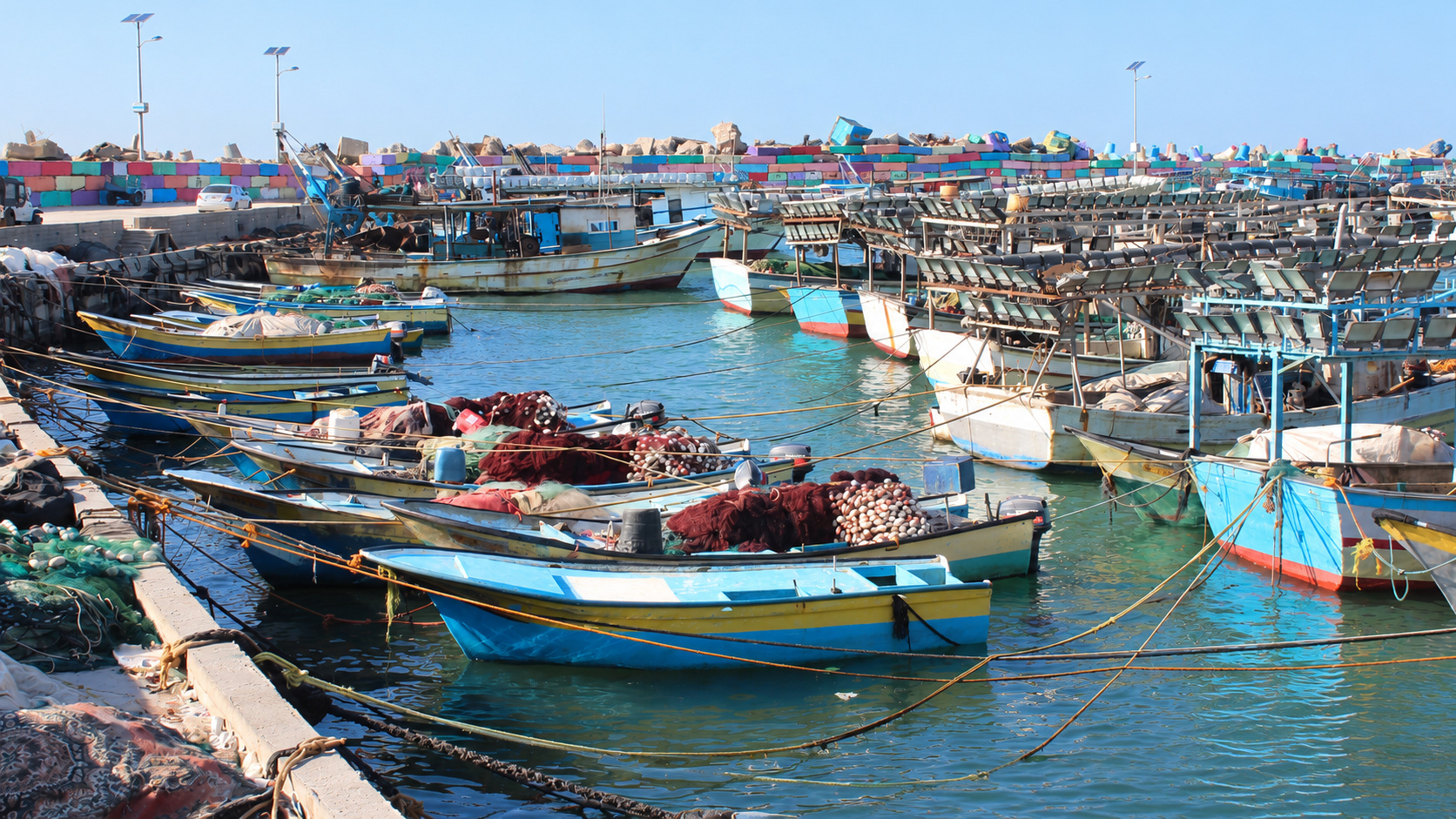
Gaza harbour, 5 March 2015. Mahmoud Navash. Original photograph · License. Framing and restrained tonal adaptation using built-in AI; a processed version of the source photograph. This archival photograph supplies context; it does not depict the survey event or map proposed borders.
Original publication Next chapter: A Gaza without Hamas: scenarios within Israel Previous chapter: Who would govern Gaza? Scenarios from an expert survey