

 Global connections
 Research & archive





Historical material. Dates, proposals and invitations refer to the time of the original publication.
An excerpt from an expert survey published in November 2023. Responses and the author’s commentary reflect positions at that time; this excerpt does not identify the respondents by name.The research question
In your opinion, is it possible for the Palestinian state to exist outside the borders established by UN Resolution 181? If yes, in what situation and under what conditions?
Different border scenarios
The ‘Green Line’ (the demarcation line after the end of the 1948-1949 Arab-Israeli War) is a ‘red line’ for Israel. Even with these borders, no one in Israel would agree. However, this ‘Green Line’ is a legitimate border for the United States, the European Union, and many Arab countries.
It is impossible. Making new UN decisions in modern conditions is practically impossible. The most realistic scenario is the implementation of UN Resolution 181.
UN Resolution No. 181 is analogous to the ‘Minsk Agreements of 2015 [editorial correction]’ (the result of a compromise achievable only ‘on paper’ — which was torn up the next day after signing). Neither side intended to implement it, each negotiating party only postponed the military (military-political) solution, counting on ‘history on its side.’ Therefore, if the United States really needs a quick solution to this problem to advance the Abraham Accords, they can, citing the suffering of the two peoples and a humanitarian catastrophe, force the parties to agree to new borders.
This is a possibility, not far from reality. A Palestinian state created outside the borders established by UN Resolution 181 would likely require special conditions and circumstances, for example, if Israel and the Palestinian leadership come to such a mutual decision, possibly with international mediation, and then the borders of the Palestinian state would be defined differently than in the original UN resolution.
The idea of two states in the Holy Land within the 1947 borders is stillborn, originally in the paradigm of Realpolitik. Even if this hypothetically happens (on the map and legally), it will NOT work on the ground.
About this chapter
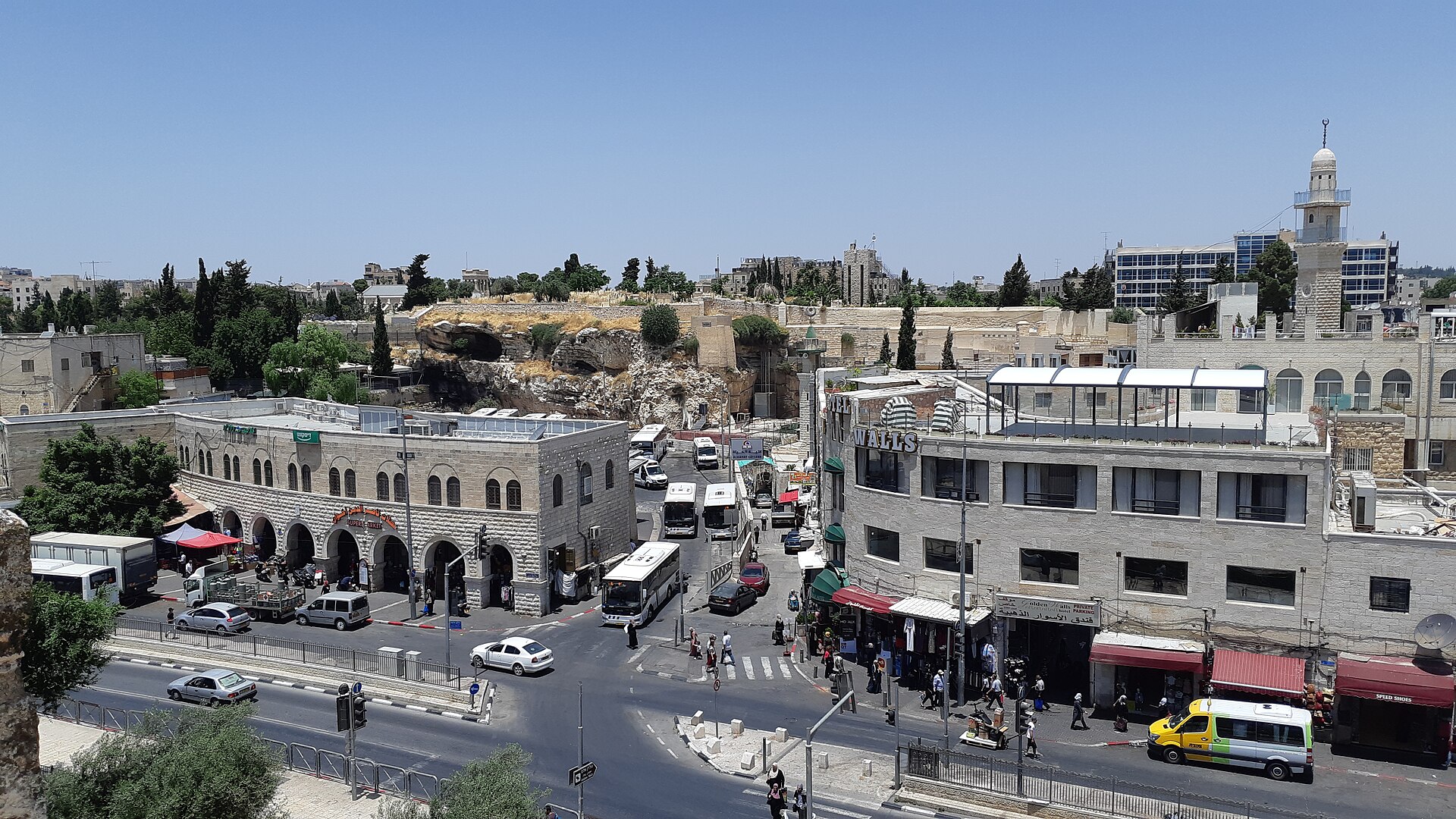
Sultan Suleiman Street, Jerusalem, 2 June 2019. Photo: McKaby · Original photograph · CC BY-SA 4.0 license. Existing Wikimedia landscape derivative, without retouching or generative editing. The photograph provides urban context; it is not a map of political borders.
The source quotation incorrectly gives the year as 1915. It is shown as “2015 [editorial correction]”: the Minsk package was adopted on 12 February 2015, following the September 2014 agreements. Only the date is corrected; the political analogy remains the respondent’s opinion. The original response is retained in history. Next chapter: Jerusalem and the question of status Previous chapter: Hamas and Palestinian statehood: three expert positions