
 Global connections
 Research & archive




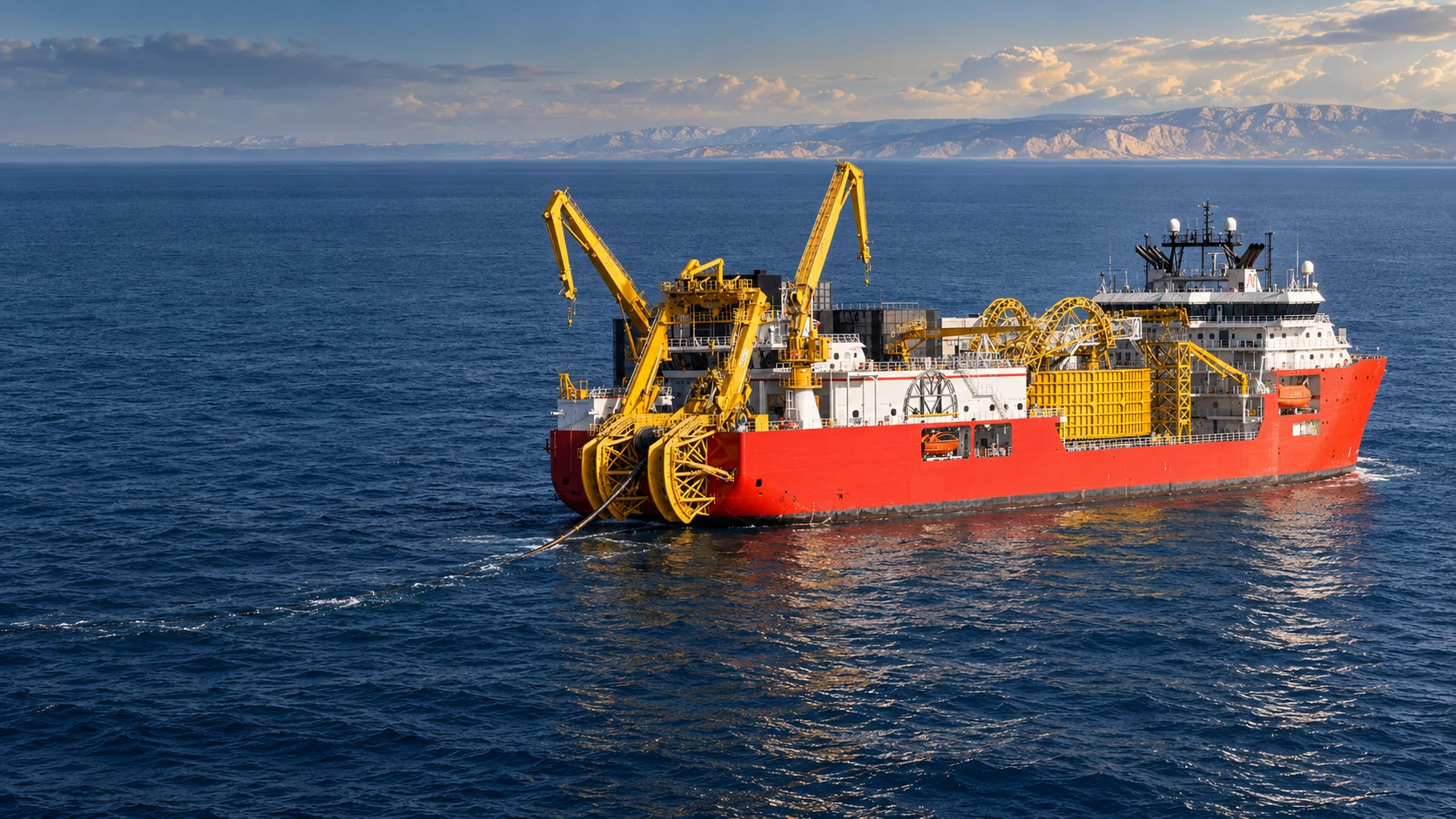




On October 20, Libya’s eastern-based parliament approved the maritime memorandum Turkey signed with the Tripoli government in 2019 and has treated as binding ever since. Ankara cited that memorandum in July 2024, when it sent warships toward a vessel surveying the seabed for the Great Sea Interconnector, the cable meant to link Israel to Europe’s power grid for the first time via Cyprus and Crete. Surveys on the disputed stretches of the route are still unfinished.
“Absolutely Null and Void”
Libya has been split in two since 2014. The west, including the capital, Tripoli, is run by a government recognized by the United Nations and currently led by Prime Minister Abdul Hamid Dbeibah. Eastern Libya is controlled by Field Marshal Khalifa Haftar, commander of the Libyan National Army. The country’s parliament, the House of Representatives, elected in 2014, holds its sessions there, in Tobruk and Benghazi. The memorandum with Turkey was signed in 2019 by the government in Tripoli, and for nearly seven years the parliament in the east refused to approve it.
On October 20, 2026, the House of Representatives voted unanimously to approve the memorandum on the delimitation of maritime jurisdiction areas[1] that Turkey signed on November 27, 2019[2], with Fayez al-Sarraj’s Government of National Accord, the Tripoli government of the day. In the same vote, the chamber restored political relations with Ankara[3], which it had cut in 2020, and lifted the 2020 ban it had placed on approving the two 2019 agreements with Turkey, the maritime accord and a military cooperation pact. Turkey’s Foreign Ministry noted on the day of the vote[1] that, for Ankara, the memorandum has been in force since 2019. President Recep Tayyip Erdoğan welcomed the decision on October 21 at a meeting of his Justice and Development Party, and Foreign Minister Hakan Fidan called[1] Dbeibah and Saddam Haftar after the vote to thank them. Saddam, Khalifa Haftar’s son, became his father’s deputy in the eastern army in 2025[4]. Jalel Harchaoui of the Royal United Services Institute in London describes him as “on the ascendancy”[5].
Greece’s Foreign Ministry said on the day of the vote[6] that ratification does not make the memorandum lawful. Turkey and Libya have no opposite or adjacent coastlines, the ministry argued. Crete lies between them, which in the ministry’s view leaves the two countries nothing to delimit. The memorandum also ignores the Greek islands, which, Athens says, are entitled to maritime zones of their own under the UN Convention on the Law of the Sea. Kaja Kallas, the European Union’s foreign policy chief, speaking for all 27 member states, called[7] the memorandum invalid and unable to have any legal effect on third countries. Egypt’s Foreign Ministry repeated on October 21[8] that it considers the document “absolutely null and void,” and Israel’s Foreign Ministry wrote the same day[9], “Regretfully, once again we see Turkey working to destabilise the east Mediterranean region.”
As recently as December 15, 2025, the speaker, Aguila Saleh, called the memorandum illegitimate and nonbinding[10]. Anas El Gomati, director of the Sadeq Institute, a Libyan think tank, described the new decision as a complete reversal[11]. By one account, Ankara threatened[12] to resume full military backing for Tripoli and to scale back its investments in Benghazi. Bilgehan Öztürk, a nonresident fellow at the Qatar-based Global Institute for Strategic Research, offers a different explanation. Turkey, he said[5], can help the Haftars with defense industry support, investment and international acceptance, and Greece has none of those tools.
A Parliamentary Coup
Ankara had been courting eastern Libya directly for more than a year. On August 25, 2025, Ibrahim Kalın, head of Turkey’s National Intelligence Organization, met[4] Khalifa Haftar and his son Saddam in Benghazi as the chamber prepared to debate the memorandum. On December 22 of that year, Turkey’s parliament extended[10] the deployment of Turkish troops in Libya to January 2028. On August 12, 2026, Fidan made his first visit to Benghazi[5], where he met Khalifa Haftar, his sons Saddam and Belgassem, and Speaker Saleh.
In early October 2026, lawmakers loyal to Saddam Haftar pushed through a rule[12] limiting the speaker’s term to 12 months, and Saleh lost his post. A Greek newspaper called it a parliamentary “coup”[12]. The chamber elected as speaker al-Salhin Abdelnabi al-Obeidi[5], the preferred candidate of the Turkish-Libyan parliamentary friendship group and, according to the same paper, a Saddam loyalist[12]. At its first session under the new speaker, the chamber ratified[1] the memorandum, and Kalın was in Tripoli that same day[5] meeting Dbeibah.
The ratification came amid an American push to reunify Libya, a plan that rests on oil. It is driven by Massad Boulos, President Trump’s senior adviser for Arab and African affairs. Boulos is also the father-in-law of Tiffany Trump, the president’s younger daughter. Under the plan, if the rival camps agree to govern together, the United States will encourage its companies to invest in Libya’s oil fields[13], and Boulos has already been nudging Libya’s National Oil Corporation toward deals with Chevron and ConocoPhillips[14]. Turkey is Washington’s partner in the effort. On June 20, 2026, Boulos discussed reunification with Fidan and the foreign ministers of Egypt and Saudi Arabia[15], and on October 23 Ankara was due to host talks between Saddam Haftar and Tripoli’s acting defense minister on merging the two armies[16]. In August, six members of Congress from both parties urged Secretary of State Marco Rubio to make the Great Sea Interconnector a policy priority[17]. The ratification Ankara secured in the middle of American mediation works against a project those lawmakers back.
Blue Homeland
In Turkey, the vote is seen as having implications far beyond Libya. Retired Adm. Cem Gürdeniz has championed the doctrine known as Blue Homeland since 2006. It stakes out Turkey’s claim to expansive maritime zones in the Aegean and the Mediterranean. He called the ratification[11] one of Turkey’s most important diplomatic achievements and a defeat for Greece, the EU and the United States. Gürdeniz tied the decision to the Great Sea Interconnector and urged Ankara to allow no seabed survey without its approval in waters it considers its continental shelf. Turkey submitted its continental shelf limits to the UN[11] on March 18, 2020, and Libya filed a map of its own shelf with the UN[12] on May 27, 2025.
Turkey has interfered with work on the cable route before. In July 2024, it deployed five warships[18] to waters between the islands of Kasos and Karpathos, where the Italian vessel Ievoli Relume was surveying for the Crete–Cyprus cable, and cited the 2019 memorandum[19]. The unfinished stretches lie in international waters east of Kasos and west of Cyprus[20]. In April 2025, unnamed Turkish defense officials said[19] the project needed Turkey’s consent to go ahead. On October 16, 2026, Turkey issued two NAVTEX notices, the standard navigational warnings to shipping[21], declaring the areas of planned work part of the Turkish continental shelf. Both cover stretches where the French vessel Abeille Marengo is to resume surveys for the cable, and the second also covers the route of the East to Med Corridor, a data cable meant to link Asia and Europe through Saudi Arabia, Cyprus and Greece.
For years, Greece had argued that the memorandum was invalid in part because the Libyan parliament had never approved it. The vote has cost Athens that argument, although Greece, the EU and Egypt still consider[12] the document void on its merits.
Not Solely a Greek Project
For Israel, the main concern is the ratification’s potential impact on the Great Sea Interconnector[11]. Ankara considers part of the route to fall within its zone and demands advance coordination of seabed surveys, and the Libyan parliament’s approval strengthens Turkey’s hand. That could delay the project, raise costs and drive away investors. The memorandum does not, however, give Turkey a right to block Israeli shipping, nor does it settle the dispute over maritime boundaries.
The project is run by ADMIE, the Greek company that operates the country’s high-voltage transmission grid. The cable has two legs. The first, from Crete to Cyprus, runs 898 kilometers, or 558 miles[19]. The second, from Cyprus to Israel, runs about 324 kilometers, or 201 miles[22]. By September 2026, about 60 percent of the seabed surveys on the first leg had been completed[19]. In August 2026, ADMIE filed an investment request for the second leg with regulators in Cyprus and Israel[22], a week after signing an agreement[23] under which the French infrastructure investor Meridiam takes a controlling stake in the company overseeing the cable’s installation.
With Israel’s gas exports flowing to Egypt and the EastMed pipeline shelved, the cable has become Israel’s main planned direct energy link to Europe[24]. On August 7, 2025, the partners in the Leviathan field signed[25] the largest export contract in the country’s history, a $35 billion deal to supply Egypt with 130 billion cubic meters of gas through 2040. The EastMed pipeline, which was to carry Israeli and Cypriot gas via Crete to Greece and Italy, lost American backing in January 2022, when the State Department sent Athens an informal diplomatic note, or non-paper, that called the project commercially unviable and a source of tension with Turkey[26]. On January 18, 2022, Erdoğan said[27] that the only route for Eastern Mediterranean gas to Europe runs through Turkey.
Israel’s own maritime zones lie outside the memorandum. On October 21, Israel’s Foreign Ministry condemned it as an infringement on the rights of Israel’s close allies in the region[9], meaning above all Greece and Cyprus. Israel has held that line from the start. In December 2019, Israel Katz, then foreign minister, said Israel officially opposed the memorandum[28] and added, “But that doesn’t mean we are sending battleships to confront Turkey.”
Greek Foreign Minister Giorgos Gerapetritis said on October 21[29] that Turkey should not interfere with the work, “given that this is not solely a Greek project. It involves French interests and European funding.” The EU has committed €657 million to the cable through its Connecting Europe Facility[30].
“An Indispensable Leader”
On June 15, 2026, Saddam Haftar held talks in Athens[31], later that month he met Rubio in the United States[32], and on August 12 he hosted Fidan in Benghazi[5]. On September 29, an Italian newspaper reported[32] that he had met Prime Minister Benjamin Netanyahu in Abu Dhabi. It cited Mohamed Buisier, a former political adviser to Khalifa Haftar, who wrote on X that “Saddam met Netanyahu to secure political support for his bid for the Libyan presidency.” People familiar with his activities say[33] Saddam wants to establish himself as an “indispensable leader.”
According to flight-tracking data, a plane Saddam Haftar uses landed in Abu Dhabi[33] shortly after Netanyahu’s. Israeli sources deny that any meeting took place[34].
Saddam Haftar has approached Israel before. In 2021, he made a secret visit to Israel[31], according to reports at the time, and offered to establish diplomatic relations in exchange for support for his camp. On the day of the vote, the same Greek paper predicted[12] that the decision would anger Israel and the United Arab Emirates, at least privately, since both have close ties to eastern Libya. Harchaoui said the same day[5] that Greece, Cyprus, Israel and the UAE had relied on a divided Libya, in part to encircle Turkey, and called the ratification a win for Saddam.
Earlier this year, Athens received assurances that there would be no ratification, including from Khalifa Haftar himself during Gerapetritis’s visit to Benghazi[12]. Ankara got the ratification.
“Here Are the Coordinates”
On October 21, Fidan demanded[29] written notification listing the planned work and its coordinates. Describing the note Ankara wants, he said, “Here are the coordinates. That is all we are asking for.” Gerapetritis replied the same day that Greece is prepared to inform Turkey of the survey but will not ask for its permission.
Abeille Marengo, which will carry out the survey, left Naples on October 23[35] and is due in Heraklion on October 27. The Greek NAVTEX for the work is expected in early November[36]. Cyprus’s energy minister, Michael Damianos, promised on October 15[37] that it would be issued by the end of the month.
The survey could go ahead without a clash[29]. Greece would authorize the work itself and notify Turkey and Cyprus in advance. Ankara would present the notice as a request for Turkish consent and issue a counter-notice, as if it had approved the work. Greece would answer with one of its own. Both countries would save face, and the vessel would complete the survey. For Israel, that would be the best outcome, because work on the route of its future cable would continue.
A worse scenario is also possible. Turkey could again send warships toward the survey vessel, this time citing a memorandum approved by the Libyan parliament. Surveys between Crete and Cyprus would then stop again. The Israeli leg of the cable begins in Cyprus, and without the link to Crete it cannot connect Israel to Europe.
Israel has little say over the cable’s fate. In practice, Athens and Ankara decide whether the Crete–Cyprus survey goes ahead. ADMIE, Meridiam, Cyprus and the EU pay for that leg, and Israel’s regulator is involved only in cost decisions on the Israeli leg.
Turkey is not the project’s only problem. Polys Lemonaris, head of the Cyprus Energy Regulatory Authority, said on October 20[35] that the Crete–Cyprus link will now be finished in January 2031, a year later than planned, and that the project will cost more than its €1.9 billion budget. The cable maker, Nexans, has committed its factory capacity to other orders through mid-2028. Cyprus says it will release its first €25 million payment only after the NAVTEX is issued.
Sources
- Hürriyet Daily News, “Türkiye welcomes Libya’s approval of key maritime deal,” October 21, 2026. hurriyetdailynews.com ↗ ↩
- United Nations Treaty Series, No. 56119, Memorandum of Understanding between Turkey and the Government of National Accord of Libya on the Delimitation of Maritime Jurisdiction Areas in the Mediterranean, November 27, 2019. treaties.un.org ↗ ↩
- JFeed, “Israel Condemns Libya-Turkey Maritime Deal Ratification,” October 21, 2026. jfeed.com ↗ ↩
- Turkish Minute, “Turkey deepens contacts with eastern Libya amid talks on contested maritime deal,” August 26, 2025. turkishminute.com ↗ ↩
- Ragip Soylu and Elis Gjevori, “Turkey secures a strategic win over Greece as eastern Libya backs the maritime deal,” Middle East Eye, October 20, 2026. middleeasteye.net ↗ ↩
- Proto Thema, “Greece rejects Libya’s ratification of Turkish-Libyan maritime deal, calling it illegal and invalid,” October 20, 2026. en.protothema.gr ↗ ↩
Show all sources (37)Collapse sources
- Proto Thema, “All 27 EU member states condemn Turkey-Libya maritime deal as ‘invalid,’” October 21, 2026. en.protothema.gr ↗ ↩
- Proto Thema, “Egypt also rejects Turkish-Libyan memorandum: ‘Absolutely null and void, with no legal validity,’” October 21, 2026. en.protothema.gr ↗ ↩
- Israel Ministry of Foreign Affairs, post on X, October 21, 2026. x.com ↗ ↩
- FDD’s Long War Journal, “Libyan parliament speaker claims maritime deal with Turkey invalid but open to renegotiation,” December 23, 2025. longwarjournal.org ↗ ↩
- Eli Leon, “A Real Strategic Danger: Israel Will Be Affected by This Turkish Rapprochement” (in Hebrew), Maariv, October 21, 2026. maariv.co.il ↗ ↩
- Nikos Meletis, “Haftar, Turkish investors and a parliamentary coup: How eastern Libya ratified the deal that erases Crete,” Proto Thema, October 20, 2026. en.protothema.gr ↗ ↩
- Sarah Shamim, “Oil for unity: What is the US mediation plan in Libya?” Al Jazeera, July 8, 2026. aljazeera.com ↗ ↩
- Majalla, “Trump’s Libya deal: a ‘forced marriage’ between East and West?” 2026. en.majalla.com ↗ ↩
- Barin Kayaoglu, “In Libya, maritime dispute could complicate Turkey’s backing of US unity push,” Al-Monitor, July 5, 2026. al-monitor.com ↗ ↩
- Amberin Zaman, “Turkey’s Libya maritime win no guarantee for Saddam Hifter’s presidential ambitions,” Al-Monitor, October 23, 2026. al-monitor.com ↗ ↩
- Neos Kosmos, “US lawmakers urge Trump to back Greece-Cyprus-Israel power link,” August 13, 2026. neoskosmos.com ↗ ↩
- Neos Kosmos, “Tensions between Greece and Turkey with warships near Greek waters,” July 24, 2024. neoskosmos.com ↗ ↩
- Brussels Signal, “Athens looks to Paris to restart power cable stalled by Turkish warships,” September 2026. brusselssignal.eu ↗ ↩
- To Vima, “What Will It Take to Unlock the Greece-Cyprus Cable?” 2026. tovima.com ↗ ↩
- Proto Thema, “Turkey issues second Anti-NAVTEX in hours, challenging Cyprus’s EEZ and EMC cable survey operations linking Asia and Europe,” October 16, 2026. en.protothema.gr ↗ ↩
- To Vima, “ADMIE Files Investment Bid for GSI’s Cyprus-Israel Leg,” August 2026. tovima.com ↗ ↩
- Euronews, “Grecia impulsa la conexión eléctrica entre Chipre e Israel con un cable submarino” (in Spanish), August 16, 2026. es.euronews.com ↗ ↩
- Ksenia Svetlova, “The EastMed Pipeline Is Dead, Long Live the EuroAsia Electricity Project,” Mitvim, January 2022. mitvim.org.il ↗ ↩
- Globes, “Leviathan partners sign $35b Egyptian gas export deal,” August 7, 2025. en.globes.co.il ↗ ↩
- Moshe Dayan Center, “Politics, War and Eastern Mediterranean Gas,” March 24, 2022. dayan.org ↗ ↩
- Moshe Dayan Center, Tel Aviv Notes, Vol. 16, No. 4, March 24, 2022 (PDF). dayan.org ↗ ↩
- New Greek TV, “Israel condemns Turkey-Libya MoU,” December 2019. newgreektv.com ↗ ↩
- Nikos Meletis, “Crete-Cyprus power cable: Diplomatic opening for surveys to resume without confrontation with Turkey,” Proto Thema, October 21, 2026. en.protothema.gr ↗ ↩
- Fast Forward, “Nicosia–Athens Standoff over the Great Sea Interconnector – Project Up in the Air.” fastforward.com.cy ↗ ↩
- Times of Israel, “Report: Netanyahu met son of powerful Libyan general in Abu Dhabi,” September 2026. timesofisrael.com ↗ ↩
- Il Foglio, “Netanyahu, Vance, Guilfoyle. The network Haftar wants to forge,” September 29, 2026. ilfoglio.it ↗ ↩
- Türkiye Today, “Libya’s Haftar seeks closer ties with Netanyahu, Trump allies: Report,” September 2026. turkiyetoday.com ↗ ↩
- i24NEWS, “The deputy of the Libyan army commander met with Netanyahu during his visit to the UAE: report,” September 2026. i24news.tv ↗ ↩
- Greek City Times, “Greece-Cyprus Cable Slips Again as Nexans Eyes 2028 Restart and 2031 Completion,” October 24, 2026. greekcitytimes.com ↗ ↩
- SigmaLive, “GSI: French vessel departs Naples as NAVTEX notice expected,” October 24, 2026. en.sigmalive.com ↗ ↩
- Cyprus Mail, “Damianos: interconnector navtex will be issued by end of month,” October 15, 2026. cyprus-mail.com ↗ ↩
Editorial illustration adapted from a photograph by Thomas Dahlstrøm Nielsen / Wikimedia Commons, CC BY 4.0; composition modified. Original photograph · CC BY 4.0