

 Global connections
 Research & archive






Historical material. Dates, proposals and invitations refer to the time of the original publication.
The research question
Can the neutralization or elimination of the organization «Hamas» affect a change in Israel’s borders? If yes, what scenarios of these changes do you consider realistic in your opinion?
On this question, like on many others, respondents provide a broad spectrum of answers, ranging from diametrically opposed views.
Scenarios discussed
- Changes in border policy and withdrawal from some territories.
- Hypothetical annexation of the Gaza Strip.
- Palestinian statehood and a return to earlier lines.
- A federal or confederal model.
- Recognition of the existing situation.
- No change because of political constraints.
Responses and constraints
«Yes, it can change. Changes in public opinion in Israel due to the absence of Hamas could potentially lead to shifts in state policy regarding border security and the access of Israeli citizens to PA territory and vice versa. This could result in Israel withdrawing from Zone B and partially from Zone C in the West Bank.»
«In the hypothetical case of Hamas disappearing from Gaza and the semi-enclave joining Israel, the maximum Israel can do is annex this territory.»
«It can change, for example, returning to the 1967 borders.» «…The disappearance of Hamas could lead to the creation and recognition of the state of Palestine. Consequently, this territory would gain state status and cease to be part of Israel’s autonomous territory.»
«When it comes to the possibility of border changes, one cannot completely rule out the ‘One State for Two Peoples’ scenario, which in the long run could be associated with the federalization of Israel and the creation of a confederation with the PA. The issue of federalization has been raised multiple times from both the Israeli and Palestinian sides. For example, as the Minister of Internal Affairs, Aryeh Deri explored the topic of decentralizing governance and federalizing Israel.»
«The creation of two states for two peoples is fixed in UN Resolution 181 of 1947, where the borders until 1967 are also defined. However, this option is currently unattainable. Therefore, there is a supposition that, considering the humanitarian catastrophe, they will push for the option within the current borders. So to say, they will move from de facto to de jure.»
Editorial note: the partition plan under Resolution 181 (1947) and the 1949 armistice lines are distinct documents and lines. The respondent’s quotation conflates them. Primary UN maps are linked below; the quotation itself and its political assessment are retained. 1947 partition plan · Comparison with 1949 armistice lines
«No, it cannot change. Israel is NOT a fully sovereign state. Sovereignty is when a state is able to ‘take a hit’ for ‘unilaterally’ changing its own borders without resorting to ‘the help of the defenders’ club. ‘The club’ will not allow expansion, and Israel will not allow reduction on its own»; «No, it cannot. Since a hypothetical change can only occur through Israel’s withdrawal from Palestinian territories, ‘the scenario of complete withdrawal from settlements will morally and ideologically destroy Israel. The Zionist idea provides a certain ‘motivating’ vision of the future: ‘Greater Israel and/or the coming of the Messiah.’ In the case of withdrawal from settlements, it can lead to armed confrontation between settlers and the IDF.»
About the source
An archival expert survey, November 2023. These are historical opinions and hypotheses; the excerpts do not name the respondents.
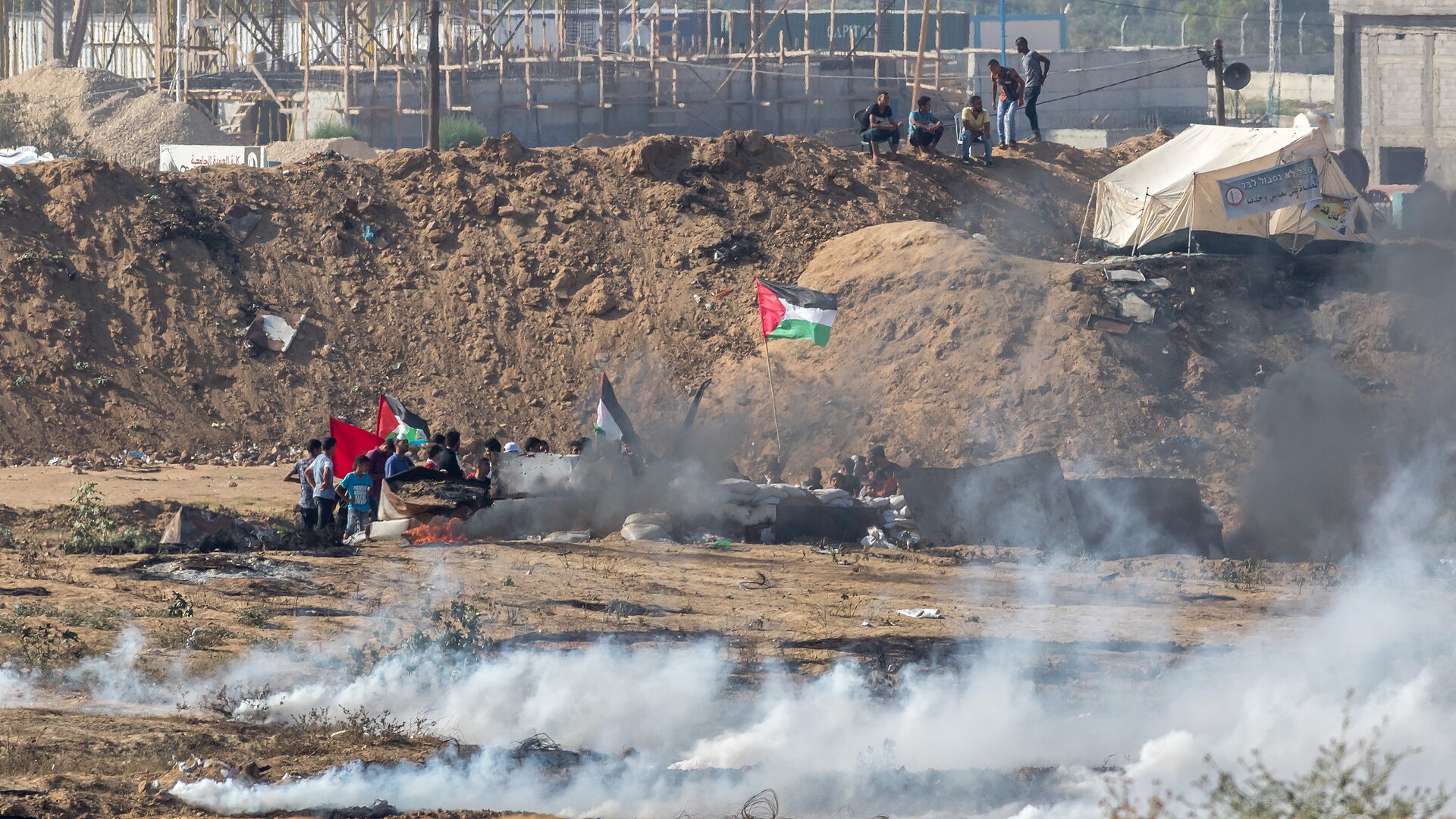
Gaza border protests, 6 July 2018. MinoZig. Original photograph · License. Existing Wikimedia landscape derivative without retouching or generative editing. This archival photograph supplies context; it does not depict the survey event or map proposed borders.
Original publication Previous chapter: A Gaza without Hamas: scenarios within Israel Next chapter: Israel and the region: experts’ diplomatic expectations